

A resinous perfume is one built around tree and plant resins, tapped saps such as labdanum, benzoin, frankincense, or myrrh, that dry into warm, balsamic, often smoky facets on the skin. The character reads as sticky, sweet, vanilla-tinged, or incense-like depending on the resin. This guide breaks down the ingredients, how they’re extracted, what they smell like, and which fragrances, including three from Rookperfumes, show the profile clearly.
TL;DR:
- Resinous perfumes often blend natural and synthetic materials to achieve consistent scent profiles and improve stability and cost-effectiveness.
- The extraction methods, such as steam distillation or solvent extraction, influence a resin’s aroma, ranging from dry and piney to sweet and syrupy.
- Resins play a crucial role in a fragrance’s longevity and structure, often providing depth and a slow-release drydown that lasts for hours.
- Seasonality, application technique, and layering significantly affect how resinous scents develop and wear on the skin.
- Testing samples over a full day is recommended before purchasing a full bottle, as resinous scents evolve considerably after initial application.
Table of Contents
- What makes a perfume resinous?
- Common natural resins and what each smells like
- How resins are extracted and used in perfumery
- How resinous notes shape a perfume’s structure and longevity
- Notable resinous fragrances and what each demonstrates
- How to wear resinous perfumes well
- Safety, sensitivity, and regulatory notes
- Why trust this guide on resinous perfumes
- The gap between how resins are described and how they actually wear
- Try a sample before you commit to a full bottle
- Sources
- FAQ
What makes a perfume resinous?
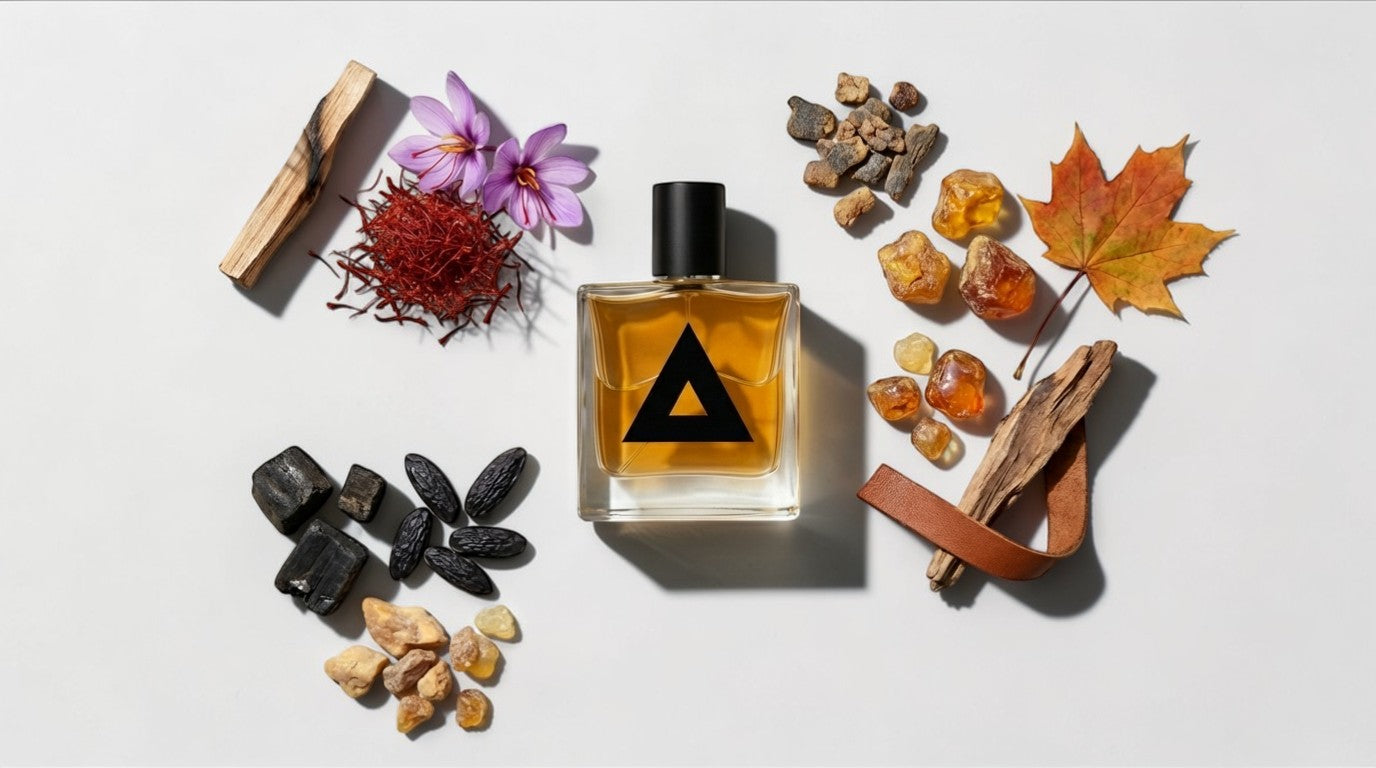
“Resinous” describes a scent lifted from tree and shrub saps rather than flowers, fruit, or fresh green material. These saps oxidise into hardened lumps that perfumers dissolve, tincture, or distil into usable materials, and the resulting smell tends to sit somewhere between sweet, smoky, and leathery. It’s an old vocabulary word in perfumery, closely tied to “balsamic” (soft, warm, vanilla-adjacent) and “amber” (a resin-driven accord built mainly from labdanum, vanilla, and benzoin rather than actual ambergris).
Enthusiasts reach for a fairly consistent set of descriptors when a fragrance leans resinous:
- Sticky or thick, as though the scent has weight rather than lift
- Warm and sweet, often with a vanilla or honeyed undertone
- Incense-like or smoky, from resins burned as church or temple incense for centuries
- Leathery or animalic, particularly with labdanum, which can smell faintly of hide
- Amber-adjacent, since most commercial “amber” accords are built from resins, not fossilised tree sap
Resinous materials rarely work alone. They’re the backbone of the woody fragrance family, where sandalwood, cedar, or oud get propped up by a resinous base to add depth and persistence. They also anchor much of the oriental and amber category, where the resin isn’t a supporting note but the whole point. A perfume can be woody without being resinous, and resinous without being especially woody, but the two overlap often enough that separating them cleanly rarely helps.
One useful distinction: resinous doesn’t automatically mean “heavy.” Frankincense-forward compositions can smell dry and almost sparse, while a benzoin-heavy base can feel like liquid vanilla. The word describes a family of raw materials, not a single mood.
Common natural resins and what each smells like
Seven resins turn up again and again in perfumery, and each brings a distinct signature rather than a generic “resin smell.”
- Labdanum: warm, leathery, faintly animalic, with an amber sweetness that makes it the backbone of most amber accords.
- Benzoin: vanillic and balsamic, almost like liquid vanilla with a resinous edge; it works hard as a fixative in the base.
- Frankincense: dry, piney, slightly citrus, the classic incense smell associated with churches and temples for millennia.
- Myrrh: dry and bitter-sweet, with a liquorice-tinged, medicinal woodiness that reads darker than frankincense.
- Styrax: balsamic and creamy, often described as having a vanilla-floral, almost leathery pipe-tobacco quality.
- Tolu balsam: cinnamon and vanilla-sweet, softer and rounder than benzoin, common in gourmand bases.
- Pine and fir resins: green, tarry, and unmistakably coniferous, closer to sap on bark than to incense smoke.
Alpha Aromatics’ guide to crafting resinous scents notes that composers typically treat these materials as base-note anchors, meaning they’re chosen for how they behave over hours rather than how they smell in the first five minutes on a blotter.
Not every resinous note in a bottle came from a tree. A meaningful share of what smells resinous in modern perfumery is synthetic or semisynthetic: aroma chemicals engineered to mimic labdanum or benzoin without the batch variation, cost, or supply issues that come with harvesting real sap. Fragrance oils frequently combine natural essential oils with synthetic aroma compounds precisely because synthetics are cheaper and more consistent when the natural material is scarce or expensive. That doesn’t make a resinous perfume “fake.” It means the industry has built reliable substitutes for materials that would otherwise be wildly inconsistent from harvest to harvest.
Absolutes (concentrated extracts) and resinoids (semi-solid resin extractions) both show up on ingredient lists too, and both behave differently in a formula than a straightforward tincture. Community discussion on threads like r/NichePerfumes shows how divisive the smell can be. Some people find it comforting and warm, others find it cloying or “churchy,” which is worth knowing before committing to a full bottle.
How resins are extracted and used in perfumery
Getting from tree sap to a bottle involves several different processes, and the method used changes how a resin ultimately smells.
- Tapping or collection: the raw method for materials like labdanum and frankincense, where resin is harvested directly from shrubs or incised tree bark and left to harden.
- Steam distillation: raw resin is heated with steam to separate out the aromatic essential oil, producing a lighter, more volatile version of the scent.
- Solvent extraction: chemical solvents pull aromatic compounds from the raw resin to create a resinoid or absolute, typically richer and closer to the original material than a distilled oil.
- CO2 extraction: pressurised carbon dioxide extracts the aromatics at lower temperatures, often preserving more of the delicate top notes that heat destroys.
- Synthetic recreation: aroma chemists rebuild a resin’s key molecules in a lab, sidestepping harvest variability entirely.
Perfumers choose between natural and synthetic resin materials largely on cost, stability, and olfactory fidelity. A natural absolute might carry more nuance and complexity, but batch-to-batch variation and price swings make it a harder material to formulate around at scale. CandleScience notes that fragrance oils blending essential oils with synthetic aroma chemicals are common precisely because they offer more consistent performance than pure naturals. In practice, most resinous perfumes you’ll encounter use a blend: a natural absolute or tincture for character, backed by a synthetic accord for stability and cost control.
You’ll see resins presented in a few different forms depending on the brand: gum resins in their rawest state, tinctures (resin dissolved in alcohol), absolutes, and standardised fragrance oils formulated specifically for perfumery use.
How resinous notes shape a perfume’s structure and longevity
Resins are why some perfumes still smell like something six hours after application while others vanish within thirty minutes. Their molecules are heavier and evaporate far more slowly than citrus or aromatic top notes, which is why perfumers use them as fixatives: base materials that anchor the more volatile ingredients above them and slow the whole composition’s evaporation rate.
A typical resinous fragrance follows a fairly predictable arc. The opening often carries citrus, spice, or a green facet that fades within the first fifteen to thirty minutes. The heart, floral or spicy, bridges the gap. Underneath both, the resinous base has been present since the first spray, simply masked by louder notes above it. As those lighter materials burn off, the resin becomes more audible, which is why resinous perfumes often smell noticeably different, warmer and sweeter, two hours in than they did on first application.
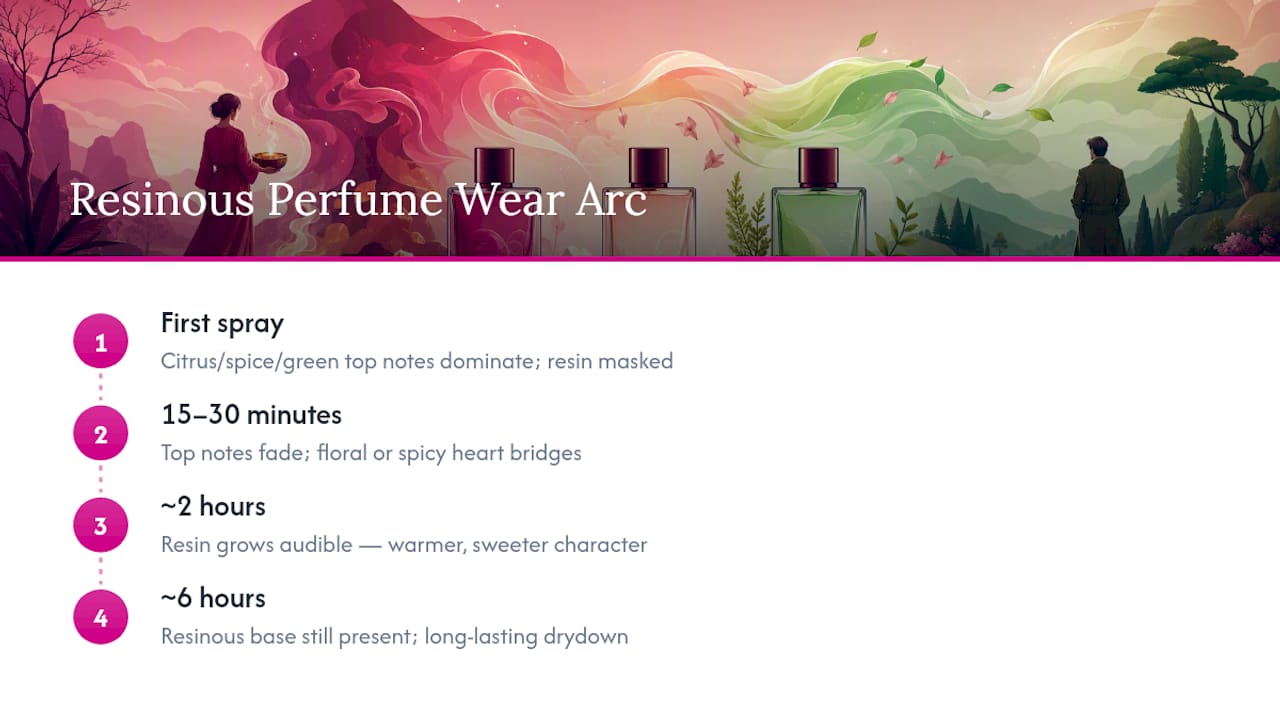
This slow-release behaviour is also why resinous perfumes tend to reward patience. Testing one on a blotter for thirty seconds tells you almost nothing about its actual character; the interesting part happens in the drydown, sometimes hours later.
The same heaviness that gives resins their longevity also explains why they suit cooler weather more than a scorching afternoon. Warm, sticky-sweet materials read as comforting against cold air and thin winter clothing, but can feel cloying and overly present in summer heat, when skin already runs warm and sweat concentrates a fragrance’s projection. Evening wear suits resinous perfumes for a similar reason: less ambient competition from daylight activity, more skin contact through close clothing, and a mood that leans toward depth rather than freshness.
Notable resinous fragrances and what each demonstrates
Resins show up differently depending on what a perfumer pairs them with, and looking at contrasting examples makes the ingredient list above far easier to place by nose.
- Incense-led compositions lean hard on frankincense and myrrh, producing a dry, smoky, almost devotional character with minimal sweetness. These tend to smell closer to a lit censer than to a dessert.
- Amber gourmands build around labdanum, benzoin, and tolu balsam alongside vanilla or spice, producing the rounded, sweet, skin-warm effect most people picture when they hear “amber perfume.”
- Coniferous resin woods use pine and fir resins alongside cedar or vetiver for a green, sappy, almost outdoor character, less sweet and more bracing than an amber composition.
- Labdanum-forward amber compositions push the leathery, animalic side of labdanum harder, producing something darker and more skin-like than a straightforward vanilla amber.
Rookperfumes carries examples across several of these lanes. The Amber Eau de Parfum, built on a smoky saffron and amber base, sits firmly in the amber gourmand category, warm, resinous, with saffron adding a spiced edge rather than straight sweetness. The Forest Eau de Parfum demonstrates the coniferous resin profile directly, pine and cedar rendered as woodland rather than perfume counter, closer to sap on bark than incense smoke. The Tea Chest Parfum takes a less obvious route: lapsang souchong tea brings its own smoky character, layered against rosewood for a resinous, woody profile that reads more like a tea caddy than a traditional amber.
Community-curated lists such as Fragrantica’s resinous fragrance threads consistently flag longevity as the standout trait across the category, which tracks with how fixative-heavy these compositions tend to be.
How to wear resinous perfumes well
Resinous perfumes reward a slightly different approach than a citrus cologne you’d spray liberally and forget about.
Season and timing matter more here than with most fragrance families. Autumn and winter suit the warmth and density of resins far better than summer heat, and evenings generally outperform bright mornings, since the mood leans toward depth rather than freshness.
Application should stay restrained. Resinous materials project further and last longer than lighter fragrance families, so two sprays on pulse points, wrists and the side of the neck, usually outperforms a heavier hand. Take care with pale or delicate fabrics, since darker resinous oils can occasionally leave a faint mark if sprayed directly onto clothing rather than skin.
Layering can lift or deepen the effect depending on what you pair. A lighter citrus or floral spray underneath can soften an intensely resinous scent for daytime wear, while stacking two resin-heavy fragrances tends to muddy rather than enhance.
Pro Tip: Resinous perfumes often smell markedly different two hours after application than they do straight from the bottle. Order a discovery sample and wear it a full day before deciding on a full bottle, rather than judging from a five-minute blotter test.
Safety, sensitivity, and regulatory notes
Resinous materials, particularly labdanum, benzoin, and styrax, sit among the more common fragrance allergens, so a patch test on the inside of your forearm before full application is worth the extra day of waiting. The International Fragrance Association (IFRA) sets usage limits on several resins and resin-derived materials specifically because of their sensitisation potential, which is one reason concentrations vary noticeably between brands using what looks like the same ingredient.
If you have reactive or sensitive skin, an oil-based resinous perfume tends to sit more gently than an alcohol-based eau de parfum, since alcohol can aggravate skin that’s already prone to irritation. Checking a brand’s ingredient list against known allergens, as explained in resources on natural versus synthetic aromatic materials, is a sensible habit before committing to daily wear.
Why trust this guide on resinous perfumes
This guide is informed by experience in sustainable sourcing and cruelty-free formulation, working directly with resinous, woody, and amber materials rather than treating them as an afterthought in a floral-first catalogue. That hands-on formulation experience shapes how this guide describes each material, ingredient behaviour observed in real compositions, not secondhand summary.
For readers who want to go further than reading about resins, the Rookperfumes scent note glossary breaks down individual notes in more depth, and the product pages referenced throughout this guide offer a practical way to smell labdanum, benzoin, and pine resin character side by side rather than taking a description on faith.
The gap between how resins are described and how they actually wear
Most perfume writing treats resinous notes as a single mood: heavy, sweet, wintery, done. That flattens a category that actually spans from bone-dry frankincense to syrupy tolu balsam, materials with almost nothing in common except a shared origin in tree sap. The conventional advice, “resinous perfumes are for cold weather and evenings”, isn’t wrong, but it undersells how differently these materials behave depending on what they’re paired with.
The bigger miss is treating resins as background material rather than the main event. A lot of buying guides mention labdanum or benzoin in passing, as though they were interchangeable base notes rather than ingredients with distinct, recognisable personalities. If you’re new to the category, prioritise smelling the raw contrast between an incense-led composition and an amber gourmand before worrying about brand reputation or bottle design. The resin is doing the work. Everything else is packaging.
— Rook
Try a sample before you commit to a full bottle
Committing to a full bottle of anything this distinctive is a real gamble if you haven’t worn it past the first ten minutes. Discovery sets exist for exactly that reason: a way to test how a resinous composition develops over hours and across different weather, without paying full price for a bottle that might smell wonderful on a blotter and wrong on your skin.
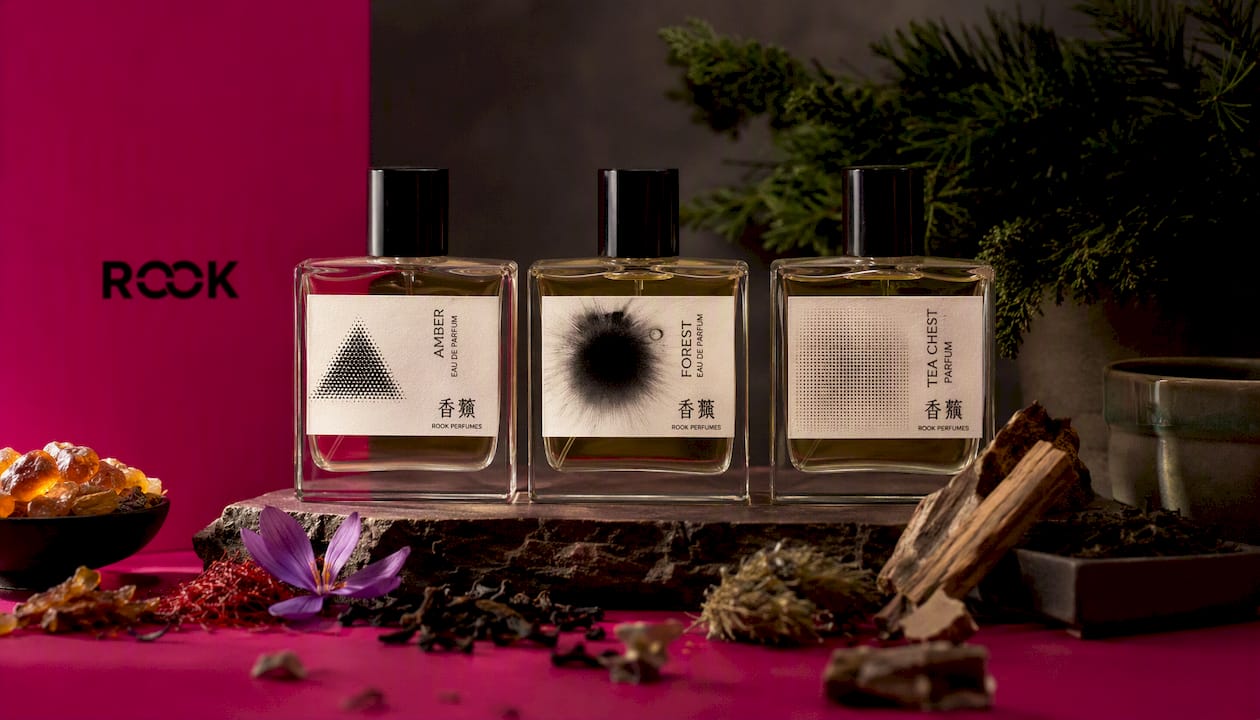
Each of the three fragrances discussed here demonstrates a different side of the resinous family. The Amber Eau de Parfum shows the smoky saffron amber gourmand style. The Forest Eau de Parfum shows the green, coniferous side of resin work. The Tea Chest Parfum shows how a resinous base can carry an unusual smoky tea character rather than a predictable amber sweetness. Start with a discovery set, wear each one a full day, and see which resin family actually suits your skin before ordering a full-size bottle.
Sources
This guide draws on Fragrantica’s resin note reference for material definitions and examples, The Perfume Society’s woody fragrance guidance for how resins support woody compositions, and CandleScience’s fragrance oil explainer alongside Wikipedia’s fragrance oil overview for extraction and synthetic-material context.
- Woody fragrances | The Perfume Society
- Fragrance oil — Wikipedia
- What are fragrance oils? - CandleScience
FAQ
What is a resinous fragrance?
A resinous fragrance is one built around tree or plant resins, such as labdanum, benzoin, or frankincense, that produce a warm, balsamic, often smoky or sweet character on the skin.
What does “resinous odor” mean?
It describes the sticky, warm, sometimes smoky or leathery smell that comes from hardened tree and plant saps, distinct from floral, citrus, or green scent categories.
What is the most seductive female scent?
There’s no single agreed answer, since preference varies enormously, but amber and labdanum-forward compositions are frequently cited by enthusiasts as warm, skin-like, and sensual due to their leathery, slow-releasing character. Rookperfumes’ Amber Eau de Parfum sits in exactly this style.
What do Muslims call perfume?
In Arabic, perfume is generally referred to as “itr” (also transliterated “attar”), a term historically associated with concentrated oil-based fragrances rather than alcohol-based sprays, many of which lean heavily on resins like oud, amber, and musk.
0 comentarios