

Scent triggers memory more powerfully than other senses because olfactory signals travel directly to the amygdala and hippocampus, the brain’s emotion and memory centres, without the filtering relay that sight and sound pass through first. A widely cited 2016 review in Behavioral Sciences found odour-evoked autobiographical memories are consistently more emotional and more transporting than memories triggered any other way. That finding shapes how fragrances can be built to reach further into memory than a typical bottle of scent ever could.
TL;DR:
- Scents that are distinctive and tied to specific contexts are significantly more effective at triggering vivid, autobiographical memories than generic or pleasant scents.
- Recognition of a smell correlates with emotional intensity, while the ability to retrieve detailed memories depends on the semantic uniqueness of that scent.
- Childhood scents form long-lasting connections due to privileged neural links, making early impressions particularly powerful for memory recall.
- Building a scent-based memory anchor involves consistent, exclusive use during learning or emotional experiences, with subtle, unusual notes being more effective.
- The effectiveness of scent-driven memory cues varies greatly between individuals, emphasizing the importance of personal, specific scent choices over universal or generic fragrances.
Table of Contents
- The olfactory pathway: how smell reaches memory before you’re even aware of it
- What the evidence actually shows about odour-evoked memory
- Why some scents work and others don’t: distinctiveness, familiarity and early imprinting
- Using scent deliberately: mood, learning and therapeutic caution
- How Rookperfumes designs scents around this science
- What scent research gets wrong when it’s oversimplified
- Try the science yourself: memory-inspired scents to sample
- Sources
- FAQ
The olfactory pathway: how smell reaches memory before you’re even aware of it
Every other sense takes a detour. Sound, sight, and touch all route through the thalamus, a kind of relay station that filters and organises sensory input before passing it on to the parts of the brain responsible for conscious thought. Smell skips that step entirely.
When an odour molecule reaches receptors high in the nasal cavity, the signal travels straight to the olfactory bulb, then on to the piriform cortex, and from there directly into the amygdala and hippocampus, the structures that generate emotion and store autobiographical memory. There’s no waiting room. A smell can trigger a feeling before you’ve consciously identified what you’re smelling at all.
That anatomical shortcut is the real explanation behind why a stranger’s perfume on a train can flood you with a memory you hadn’t thought about in years. Nature’s reporting on olfaction confirms that olfactory neurons project into these regions in a way visual and auditory signals simply don’t, which is why smell so often reaches emotion first and identification second.
A few mechanisms make this pathway especially good at building and holding onto memory:
- Direct limbic access. The amygdala and hippocampus sit right next to the olfactory bulb structurally, which is thought to explain why smell memories arrive already coloured by feeling, rather than feeling arriving afterwards as a reaction.
- Dopamine involvement. Reward and pleasure signalling gets tangled up with olfactory processing, reinforcing certain scent associations over repeated exposure.
- Long-lived granule cells. Neurons formed early in life within the olfactory bulb persist for decades, forming what researchers describe as privileged connections to reward centres, a mechanism that shows up again when we look at why childhood scents hit so hard.
- Physiological correlates. Odour-evoked retrieval changes measurable things like breathing pattern and blood flow to the amygdala, evidence that this isn’t just a figure of speech; the body responds as though the moment is happening again, a pattern the Nature piece documents directly.
None of this makes smell magic. It makes it structurally different. Where a photograph asks your brain to reconstruct a memory through conscious effort, a scent can activate the emotional core of that memory almost instantly, because the wiring gives it a head start.
What the evidence actually shows about odour-evoked memory
The research here divides into two separate questions that get conflated constantly: does a smell feel familiar, and does a smell pull up a specific memory? These are not the same mechanism, and mixing them up is where a lot of popular writing on scent goes wrong.
The 2016 review by Rachel Herz remains the anchor citation in this field. It found that autobiographical memories triggered by scent are rated by participants as more emotional and more effective at transporting them back to the original time and place than memories triggered by photographs, sounds, or verbal cues describing the same event. That’s a meaningful distinction. It’s not that scent memories are simply more frequent. They’re qualitatively more vivid.
A more recent 2025 cognitive study involving 106 participants dug further into the mechanism and found something researchers hadn’t cleanly separated before: odour recognition (does this smell familiar) and odour associative retrieval (this smell brings back a specific memory) run on different cognitive logic. Recognition tracks with emotional intensity, particularly for unpleasant smells. Associative retrieval, the kind that actually pulls up a memory of a person or place, depends far more on how semantically distinctive the smell is, and follows a U-shaped curve with familiarity: scents that are too novel or too generic underperform compared with ones that sit in a specific, recognisable but not overly common middle ground.
A notable result from that study: the researchers found associative memory retrieval collapsed into a single, rapid process when odour-context bindings were strong, meaning a distinctive scent tied tightly to one specific episode could trigger recognition and full episodic recall almost simultaneously, rather than as two separate steps.
Earlier laboratory work backs this up from a different angle. A 2014 Frontiers experiment paired odours with learning episodes and found that:
- Odours paired with episodic contexts improved accurate recall of those episodes later.
- Retrieval was modulated by emotional intensity regardless of whether the smell was pleasant or unpleasant.
- Physiological markers, including breathing rate, shifted measurably during odour-triggered retrieval, not just self-reported feeling.
Put together, this tells us something practically useful: a memory-evoking scent works better when it’s distinctive rather than merely pleasant, and its emotional charge matters more than its objective quality.
Why some scents work and others don’t: distinctiveness, familiarity and early imprinting
If emotion alone explained memory triggers, the most powerful scent in your life would be whichever smell you find most pleasant. It rarely is. The scent that undoes you is usually specific, sometimes even a little strange, and tied to one exact context rather than a general category.
That’s the U-shaped familiarity effect showing up again. Semantic distinctiveness predicts associative retrieval far better than pleasantness does, and highly generic smells, the ones that could belong to any number of memories, tend to be weaker cues than ones with a narrow, specific identity. A candle marketed as “fresh linen” struggles here precisely because it’s designed to smell like everything and therefore nothing in particular.
Early-life exposure adds another layer. The long-lived granule cells mentioned earlier form during childhood and stay functionally active for decades, which helps explain the so-called Proustian pattern: adults reporting startlingly vivid recall from a scent last encountered at age six or seven. Research on this early encoding mechanism suggests these neurons form privileged links to reward circuitry precisely because they were laid down during a developmentally sensitive window, not because childhood memories are inherently more important.
There’s also what you might call the password problem. A scent memory often needs near-exact matching to fire correctly, the way a password needs to be typed precisely rather than approximately. A close relative of the original smell can feel oddly wrong rather than nostalgic, because the associative system was tuned to one specific chemical signature, not a family of similar ones.
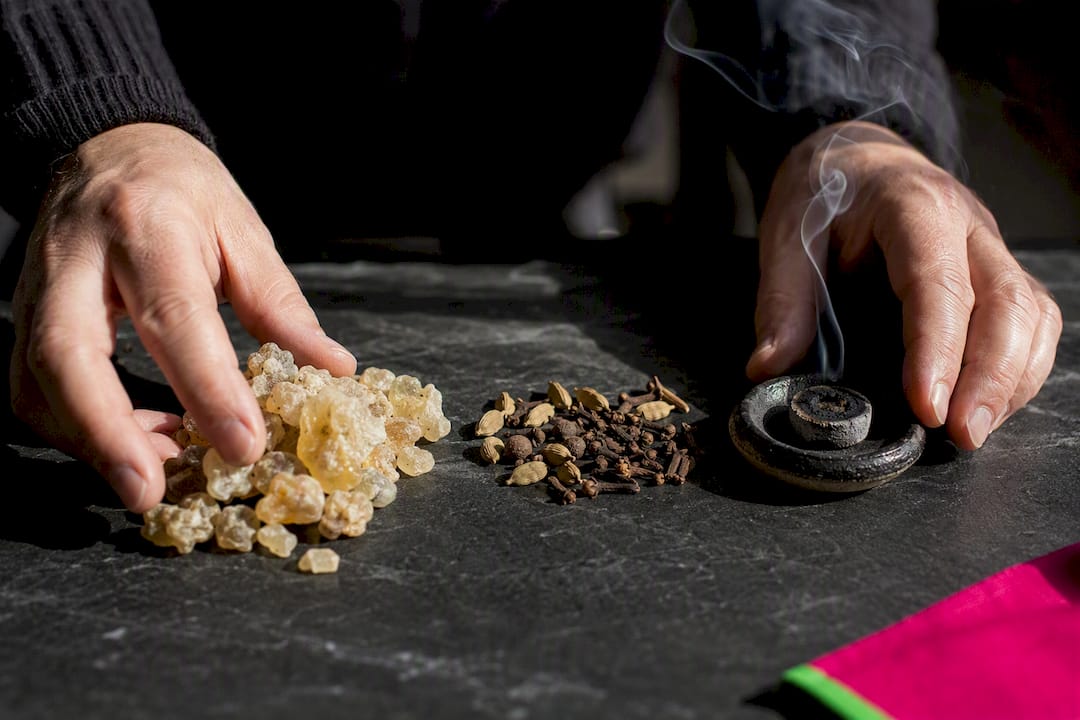
Pro Tip: If you’re trying to build a scent memory deliberately, whether for study recall or simply to anchor a good period of life to something you can return to, choose something unusual rather than universally pleasant. A common vanilla or fresh-linen scent is competing with thousands of prior associations. A specific, slightly unusual note, like a particular type of smoke, resin, or spice, has far less competition for that memory slot.
Using scent deliberately: mood, learning and therapeutic caution
Once you understand the mechanism, using it deliberately becomes fairly straightforward, though the effect sizes in this area vary and nobody should treat scent as a substitute for established study or clinical technique.
For learning and recall, a simple pairing method draws directly from the Frontiers experimental design:
- Pick one distinctive scent and reserve it exclusively for one specific study period or task, so it doesn’t get diluted across unrelated contexts.
- Apply it at the start of the session, while you’re actively encoding the material, not passively in the background.
- Re-expose yourself to the same scent shortly before recall, whether that’s an exam, a presentation, or simply trying to remember where you left something.
- Keep the association narrow. Using the same scent for multiple unrelated tasks weakens the specific link you’re trying to build.
- Repeat consistently across a revision period rather than a single session, since the encoding strength seems to build with repetition.
A relevant finding here: small studies referenced in Nature’s coverage of smell and memory show pairing a scent with learning and again at recall or during sleep can improve later performance, though the researchers are careful to note effect sizes and replication vary considerably between studies.
For mood regulation, the logic runs the same direction but with a gentler goal: keeping one specific, positive-period scent aside deliberately, so it’s available as a fast route back to a particular emotional state rather than a vague “self-care” gesture.
Clinical applications exist too, but they need a caveat that’s easy to skip past. Harvard Magazine’s coverage of scent and health notes real therapeutic interest in reminiscence therapy, particularly for older adults and dementia care, where a familiar scent can support recall and wellbeing. Scent cues also come up in PTSD research, though there specifically as something to manage carefully rather than deploy casually, since a trauma-linked odour can trigger distress as readily as a pleasant memory can trigger comfort. Anyone exploring scent in a therapeutic context involving trauma, memory loss, or a diagnosed condition should do so with a qualified clinician involved, not through self-directed experimentation.
How Rookperfumes designs scents around this science
Narrative-led perfumery, at its best, isn’t about chasing the most universally pleasant accord. It’s closer to what the distinctiveness research suggests: building a scent with enough specificity that it lands on one particular memory rather than a diffuse category of “nice smells.” Fragrances can be built around semantic descriptors, specific settings, objects, textures, rather than abstract mood words, because specificity is what the cognitive research says actually works.
Three fragrances illustrate the approach without making any clinical claim about what they’ll do for any individual:
- School Eau de Parfum leans into the specific, slightly institutional smell of classrooms, chalk, wood, paper, aiming at a very particular childhood register rather than nostalgia in general.
- Acresford Eau de Parfum pairs smoky rose with cedar, a combination distinctive enough to sidestep the generic-floral problem the research flags as weak for associative retrieval.
- Amber Eau de Parfum uses smoky saffron, an unusual enough note that it’s more likely to anchor to a specific moment than a familiar amber-vanilla blend would.
The discovery sample sets, which include a £20, £25 or £30 voucher (depending on the set) towards a future full bottle, exist partly because this science is genuinely personal. A scent that anchors one person’s most vivid memory may do nothing for someone else, and the only real way to find out is to try it directly.
What scent research gets wrong when it’s oversimplified
The popular version of this topic tends to flatten a genuinely nuanced set of findings into something closer to folklore: smell is “the memory sense,” full stop. That’s not quite what the evidence shows. What it actually shows is that emotion and distinctiveness do most of the work, and pleasantness barely factors into whether a scent successfully triggers a specific memory rather than a vague sense of familiarity.
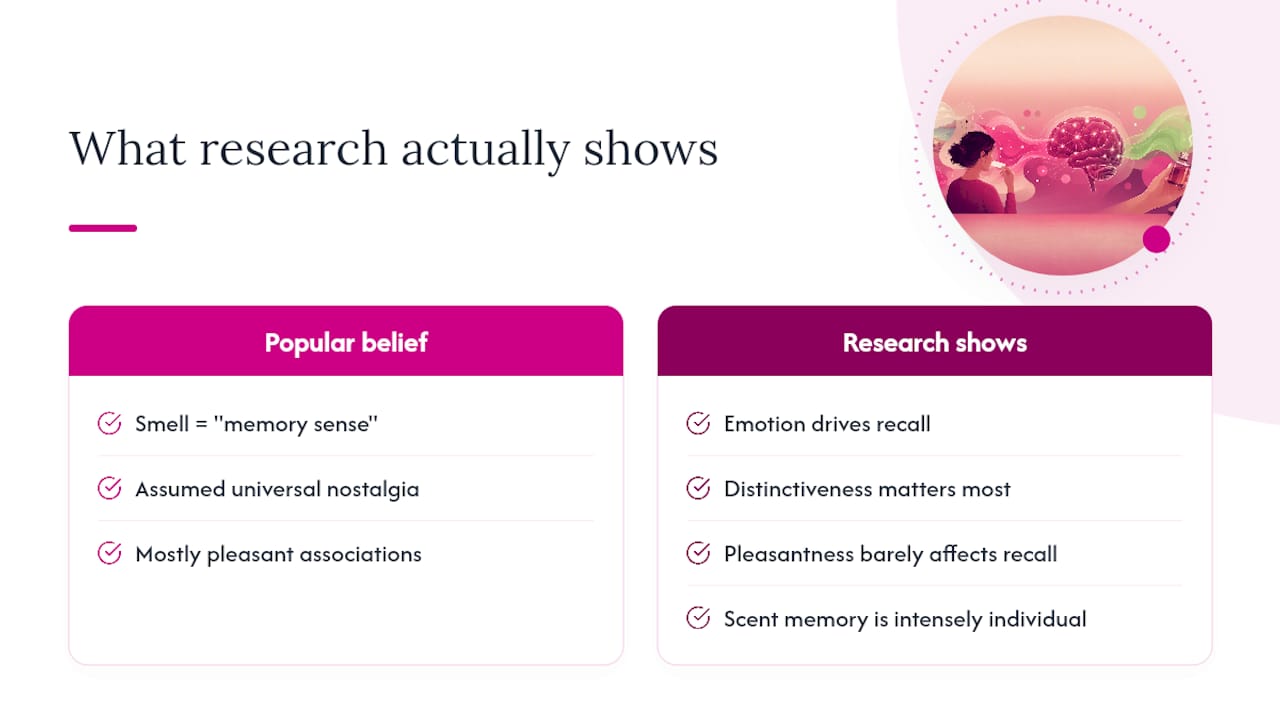
The part that gets missed most often, and that we think matters more than the industry gives it credit for, is that scent memory is intensely individual. A note that transports one person straight back to a specific childhood summer might mean nothing to someone raised somewhere else, in a different decade, around different smells entirely. That’s not a flaw in the science. It’s the reason mass-market “universal nostalgia” scents tend to underperform against something built with a narrower, more specific story in mind.
There’s also a responsibility that comes with working in scent memory. Because the amygdala doesn’t distinguish good associations from painful ones, any scent powerful enough to unlock joy is equally capable of unlocking distress for someone with a different history attached to it. Building fragrances with that in mind, rather than assuming every strong reaction is a good one, is part of doing this work honestly. If any of this has made you curious about your own scent memory, the discovery set is a low-pressure way to find out what actually moves you.
— Rook
Try the science yourself: memory-inspired scents to sample
The clearest way to test any of this on yourself is to sample rather than commit. Rookperfumes’ discovery sample sets let you try multiple memory-focused fragrances before buying a full bottle, and each set comes with a £20, £25 or £30 voucher (depending on the set) towards a later purchase, which makes the exploration essentially cost-neutral if you find one that lands.
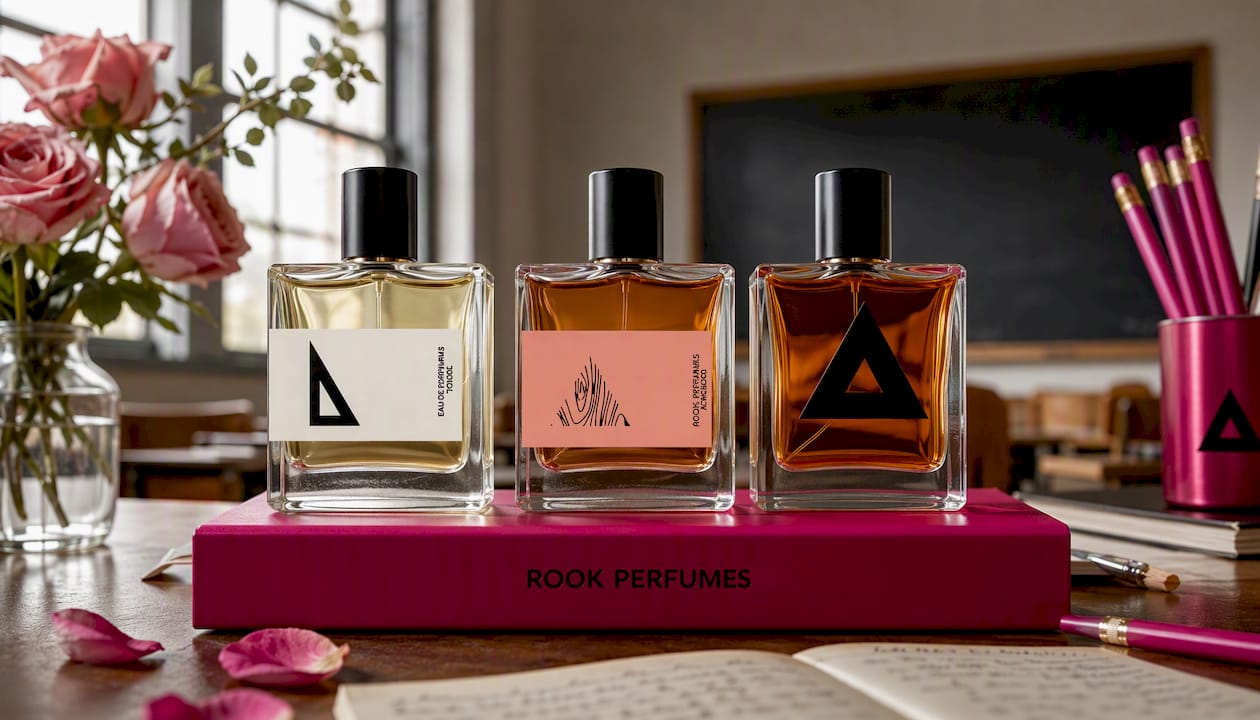
Three fragrances worth starting with, each built around a distinct sensory story rather than a generic mood: School Eau de Parfum for the specific texture of classroom nostalgia, Acresford Eau de Parfum for its smoky rose and cedar combination, and Amber Eau de Parfum for its unusual smoky saffron profile. Every fragrance is unisex and cruelty-free, made with sustainable practices.
If a scent’s distinctiveness is what determines whether it becomes a genuine memory anchor for you, the full discovery set is the most direct way to test that against your own history. Order a set, try each fragrance over a few days rather than all at once, and see which one, if any, pulls something specific rather than just something pleasant.
Sources
- The Role of Odor-Evoked Memory in Psychological and Physiological Health (Rachel S. Herz, 2016)
- A unique memory process modulated by emotion underpins successful odor recognition and episodic retrieval in humans (Frontiers, 2014)
- Unpicking the link between smell and memories (Nature, 2022)
FAQ
What is the strongest trigger to memory?
Smell is widely considered the sensory trigger most closely linked to vivid, emotional autobiographical memory, because olfactory signals bypass the thalamus and connect directly to the amygdala and hippocampus.
Is smell the most powerful memory trigger, or does that depend on the person?
It depends heavily on the individual scent and the person’s history with it. Research on odour-evoked memory shows smell-triggered memories are rated more emotional and transporting on average, but distinctiveness and personal association matter more than the sense itself.
What is the smell test for dementia?
Smell identification tests ask patients to identify a set of common odours, since reduced ability to detect or name smells can appear early in some forms of dementia; this is used clinically alongside other assessments, not as a standalone diagnosis.
Do scents improve memory or just make recall feel more vivid?
Both, to a degree. Small studies referenced in Nature’s reporting show pairing a distinctive scent with learning and again at recall can improve performance, though results vary and haven’t been consistently replicated at scale.
Why do some perfumes trigger stronger memories than others?
Semantic distinctiveness is the key factor. The 2025 cognitive study found generic or overly familiar scents are weaker memory cues than specific, less common ones, which is why narrowly defined fragrances tend to anchor memory more reliably than broad, crowd-pleasing blends.
0 comentarios