

Mineral perfumes are crafted, abstract accords that reproduce wet stone, saline air and ozonic freshness using named aroma molecules such as Calone and Ambroxan. No natural extract delivers this smell alone; perfumers build it. This guide breaks the accord into its sensory subtypes, explains the raw materials behind it, and shows you how to test, wear and find fragrances that carry it, including a few routes into it through Rookperfumes.
TL;DR:
- Mineral notes encompass several impressions, including wet stone, sea salt, metallic, chalky, and ozonic scents, each with distinct characteristics.
- Synthetic molecules such as Calone, Ambroxan, Iso E Super, Norlimbanol, and aldehydes primarily create mineral accords, with specific roles and typical usage levels.
- The evolution of mineral notes depends on volatility, skin chemistry, and temperature, affecting how a fragrance shifts from fresh top notes to warm drydowns.
- Proper testing involves observing changes over several hours on blotters and skin, avoiding rubbing to preserve the mineral’s crystalline effect.
- Exploring a fragrance discovery set is the best way to learn mineral textures and find scents that evoke place and atmosphere authentically.
Table of Contents
- The mineral scent spectrum: wet stone, sea salt, metal and chalk
- Inside the formula: the molecules that create a mineral accord
- How mineral notes evolve on skin, and how to test them properly
- Finding mineral textures worth exploring
- Why mineral textures matter to us
- Try mineral textures before you commit
- Sources
The mineral scent spectrum: wet stone, sea salt, metal and chalk
“Mineral” is not one smell. It is a family of related but distinct impressions, and once you learn to separate them, you will notice mineral facets in fragrances you thought you already knew.
Wet stone and petrichor is the smell of rain hitting warm pavement or river rocks pulled from a stream. It reads as cool, slightly damp and faintly mossy, and it tends to sit in the heart of a composition rather than the opening, because it needs a beat to register once the initial spray has settled.
Saline and sea spray notes carry the salt-and-air quality of standing near open water. Think of the smell clinging to a coastal jumper after a walk along a beach. This subtype often appears early, in the top notes, because the molecules responsible for it are highly volatile and evaporate fast.
Metallic or oxide impressions are sharper and colder, closer to the smell of a coin held in the palm or iron filings on a workbench. This is one of the more unusual mineral registers, and used sparingly it gives a fragrance a distinct, slightly dangerous edge rather than a soft, ambient one.
Chalky or powdery mineral notes read as dry and soft, closer to talc or the dust that rises from a piece of unglazed pottery. It usually shows up in the base, working alongside musks and woods to soften whatever sharper mineral note opened the fragrance.
Ozonic or atmospheric notes are the most abstract of the group: the smell of air itself just before or after a storm, sometimes described as “clean” in a way that has nothing to do with soap. Fragrantica’s overview of mineral notes describes this cold, clean quality as coming from inorganic matter such as flint, chalk or granite after rain, built from both trace natural elements and synthetic aroma chemicals.
A few things shape how you actually experience these notes:
- Volatility dictates placement. The lightest ozonic and saline molecules evaporate quickest, so they open a fragrance; heavier, chalkier materials linger and anchor the base.
- Skin chemistry changes intensity. Drier skin tends to mute volatile top notes faster, so a mineral opening can vanish within minutes on some wearers and linger closer to twenty on others.
- Temperature amplifies volatility. Warm skin releases mineral top notes faster and more intensely than cool skin, which is worth knowing before you judge a fragrance too quickly on a cold day.
- Layering shifts the register. Pairing an ozonic top note with a woody base pulls the overall impression toward “wet stone in a forest” rather than “sea spray,” even though the same mineral molecule is doing the work in both.
None of this is accidental. Practitioner analysis of mineral perfumery treats mineral notes as a contemporary fantasy accord, meaning perfumers choose exactly which of these five registers to emphasise and build the formula around that choice.
Inside the formula: the molecules that create a mineral accord
Nobody distils a mineral note from an actual stone. The entire category exists because a small set of synthetic molecules, developed over the past few decades, can trigger a mineral impression in the brain even though none of them smell like rock on their own.
Calone and calone analogues are the backbone of most saline and ozonic effects. Discovered in the 1960s and popularised through 1990s aquatic fragrances, Calone produces a melon-tinged sea-spray quality that reads as unmistakably marine even in trace amounts.
Ambroxan and Cetalox contribute the dry, saline amber quality found in the drydown of many mineral compositions. Both are ethical, stable substitutes for ambergris, which is scarce and difficult to source responsibly; CA Perfume’s ingredient guide notes that synthetics like these give perfumers consistency that natural materials simply cannot guarantee batch to batch.
Iso E Super supplies the airy, almost transparent woodiness that keeps a mineral accord from feeling flat or one-dimensional. It is nearly odourless in isolation at low doses but radically changes texture in a blend.
Norlimbanol brings a dry, dusty, almost concrete-like woodiness. It reads as closer to stone or cement than to timber, which makes it a favourite when a perfumer wants a mineral note to feel architectural rather than aquatic.
Aldehydes add the sharp, slightly metallic lift you associate with classic “clean” fragrances. In a mineral context, they push a composition toward the oxide or flint register rather than the softer chalky one.
The table below shows how these materials typically behave at concentrate level, based on the practitioner ranges described by CA Perfume and Olfactive Aesthetics.
| Molecule | Mineral character | Typical role | Approximate usage in concentrate |
|---|---|---|---|
| Calone | Marine, ozonic, melon-tinged | Top note, opening lift | 1 to 5 percent |
| Ambroxan / Cetalox | Dry, saline amber | Base, drydown anchor | Low, blended with other ambers |
| Iso E Super | Airy, transparent wood | Heart to base, texture | Variable, often a supporting percentage |
| Norlimbanol | Dry, dusty, concrete-like | Base, structural weight | Low, used sparingly for its strength |
| Aldehydes | Sharp, metallic, clean | Top note, oxide effect | Trace amounts, highly potent |
To show how these pieces fit together, here is an illustrative “concrete accord” inspired by the balancing logic described in the Olfactive Aesthetics practitioner breakdown. This is an educational sketch, not a commercial formula, and it is not intended for anyone to mix at home.
- A generous proportion of hedione for lift and diffusion
- Iso E Super for the airy, abstract woody texture
- Cashmeran for a textured, slightly musky woodiness
- Ambroxan for the dry, saline amber base
- A minute trace of Calone to add the marine, ozonic highlight
Pro Tip: If you want to train your nose on this accord family, smell Ambroxan and Calone separately on blotters before trying a finished fragrance. Once your brain files each one individually, spotting them inside a blend becomes far easier.
Some of these molecules are potent enough that concentrated forms are handled carefully in professional labs, and none of this is guidance for home blending. Understanding what is in the bottle is different from working with raw materials yourself.
How mineral notes evolve on skin, and how to test them properly
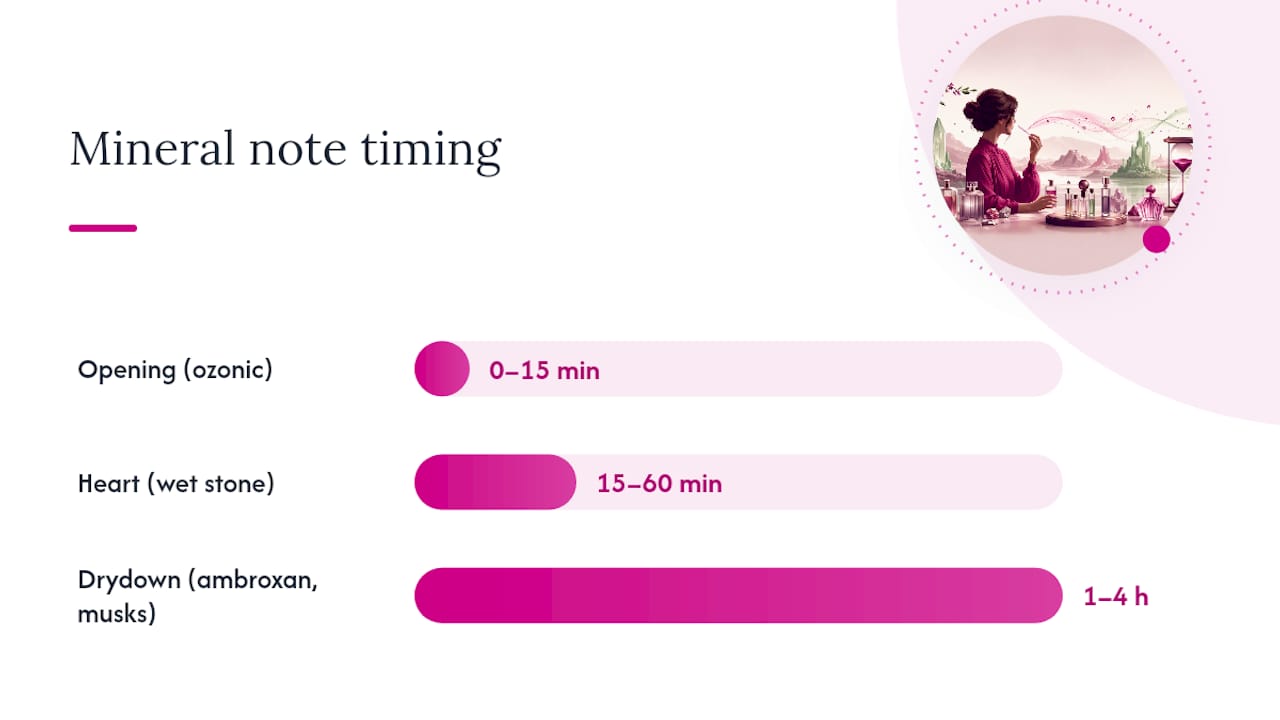
A mineral perfume rarely smells the same at ten minutes as it does at three hours in. The volatile ozonic and saline molecules front-load the opening, then step back as slower, heavier materials take over.
The typical arc runs: a bright, cold ozonic or saline burst in the first few minutes, followed by a heart where wet stone or metallic facets settle in, and finally a drydown where Ambroxan, woods and musks turn the accord dry, warm and abstract. CA Perfume’s guide notes that because these materials sit at low percentages, they behave as top or heart notes far more often than as long-lasting base notes, which is exactly why the opening can feel dramatic and the drydown feel comparatively quiet.
There is also a physical dimension to how mineral notes register. Fragrantica’s note overview points out that some mineral accords produce a trigeminal effect, a cold or tingling sensation alongside the smell itself, which is part of why a good mineral fragrance can feel tactile rather than purely olfactory.
To test a mineral fragrance properly:
- Start on a blotter. Spray once and hold it a few centimetres from your nose, noting the very first impression before it shifts.
- Wait five to fifteen minutes, then smell the blotter again. The ozonic top note should be softening by now, revealing what sits underneath.
- Apply to skin at a pulse point and leave it alone. Do not smell it again for at least twenty minutes.
- Check back at one hour and again at three or four hours to track how the mineral facet shifts from bright and cold towards dry and ambery.
- Compare environments. A mineral fragrance can read differently indoors under warm lighting than outdoors in cool air, so testing in both settings gives a fuller picture.
Application technique matters more with mineral fragrances than with heavier orientals or gourmands. Spray onto skin rather than rubbing wrists together afterwards; friction generates heat, and heat accelerates evaporation of the very volatile molecules that give the opening its crystalline character. Rubbing essentially burns off the effect you paid for.
Pro Tip: If a mineral fragrance feels harsh or too metallic on you specifically, try layering it over an unscented moisturiser rather than applying it to bare skin. This softens the sharper aldehydic or oxide facets without dulling the ozonic lift.
If a mineral note reads as unpleasant or oddly synthetic on your skin, it is not necessarily the fragrance’s fault. Try a patch test on a different area, or test again after adjusting your skincare routine, since heavily fragranced lotions or oils underneath can clash with an ozonic top note in ways that are hard to predict from the bottle alone.
Finding mineral textures worth exploring
Spotting a mineral-leaning fragrance before you even spray it is a learnable skill. Look for note lists that mention ozone, sea salt, flint, silex, wet stone or “concrete,” and pay attention to brand language around atmosphere, weather or coastlines, since that framing usually signals an ozonic or saline backbone.
Several fragrances are built around textures that sit close to this family, even where mineral is not the headline note. Forest, with its pine and cedar structure, gives you a dry woody base that layers well under an ozonic top note, pushing the overall impression towards damp forest stone rather than open water. Undergrowth leans directly into petrichor and earthiness, making it one of the closest matches in the catalogue to the wet stone register described earlier. Amber demonstrates how an Ambroxan-driven base can support a mineral drydown even in a warmer, smokier composition. Suede and its leather structure offer a chalky, dusty counterpoint worth layering against something brighter.
A discovery set is the most sensible way to explore this territory, since it lets you compare how mineral and near-mineral facets shift across several fragrances without committing to full bottles. Try this simple layering experiment: apply one fragrance with a dry, woody base to one arm and a fresher, more ozonic-leaning scent to the other, then compare how each reads after thirty minutes. It teaches your nose the difference between a natural drydown and a deliberately engineered mineral opening far faster than reading a note list ever will.

When evaluating any fragrance for mineral character, ask three questions at each stage: does the opening feel cold or bright in a way that suggests air and salt; does the heart introduce something stony, damp or metallic; and does the drydown turn dry and abstract, or does it soften into something sweeter and warmer instead. Those three checkpoints will tell you more about a fragrance’s mineral DNA than any marketing copy.
Why mineral textures matter to us
Mineral notes let a perfume speak about place rather than person. A wet stone accord doesn’t ask you to think about flowers or skin; it puts you somewhere, on a coastline or after a storm, and that atmospheric quality is part of why we keep returning to this register at Rookperfumes.
Sourcing plays into that choice as much as the smell itself. Building a mineral impression from Ambroxan or Cetalox instead of pushing towards a rare, difficult-to-trace natural extract means the ethics of the ingredient match the ethics we want the finished fragrance to carry. It is one small way sustainable, cruelty-free formulation shows up in something you can actually smell, not just read about on a label.
There’s a particular satisfaction in building an accord that people struggle to name. When someone smells a mineral note and reaches for words like “cold” or “clean” before they land on anything more specific, that hesitation is the point. A scent that resists easy description tends to be the one that lingers in memory longest.
— Rook
Try mineral textures before you commit
The clearest way to know whether a mineral accord suits you is to smell it on your own skin over several hours, not from a description in an article. Discovery sets are designed for exactly that, letting you compare fragrances like Forest, Undergrowth and Amber side by side before choosing a full bottle.

If you have already found a scent that speaks to you, the collection extends into wearable pieces too. The Forest unisex t-shirt and the Amber unisex t-shirt carry the same woodland and smoky-amber identity as their namesake fragrances, while the Suede unisex t-shirt pairs naturally with the leather composition it references. Start with a discovery set, find the accord that pulls you in, then browse the full Rookperfumes collection to build out a full bottle and the merchandise that matches it.
Sources
- Mineral notes in perfumery: capturing stone, salt & concrete in scent
- Mineral notes — Fragrantica note page
0 kommenttia