

Plastic free perfume packaging means every component the customer touches, the bottle, closure, pump, box and insert, contains no conventional or bio-based plastic and can be composted or recycled without special processing. Before trusting any claim, check three things: whether the pump and collar separate from the glass by hand, whether the box and inserts carry a real certification rather than a green leaf logo, and whether the brand offers a refill. Moulded-pulp or mycelium inserts and refillable, separable bottles are the two most credible signs a brand has actually done the work.
TL;DR:
- Most plastic-free perfume packaging relies on separable components, like molded pulp or mycelium inserts and refillable bottles, to facilitate recycling or composting.
- Cushioning for glass bottles is achieved with shock-absorbent materials like pulp and mycelium, which must be tested with prototypes and drop tests specific to each bottle shape and weight.
- Plastic often remains hidden in pumps and collars, making it essential to verify if closures are removable and if the entire packaging is truly separable for recycling or composting.
- Transitioning to plastic-free packaging involves higher costs and longer sourcing times, but brands can mitigate this by setting clear requirements and negotiating minimum order quantities early.
- Certifications such as ISCC PLUS and FSC are crucial to verifying the sustainability claims of packaging materials, preventing greenwashing in marketing.
Table of Contents
- Plastic free perfume packaging: materials that actually replace plastic
- Protecting the glass without a scrap of plastic foam
- Closures and pumps: where hidden plastic usually survives
- Keeping the unboxing feeling premium without plastic
- Compostable, recyclable, or neither: reading the small print
- A practical roadmap for brands switching to plastic-free packaging
- What Rookperfumes has learned making packaging decisions
- Why we accept the trade-offs
- Try plastic-free fragrance packaging for yourself
- Sources
- FAQ
Plastic free perfume packaging: materials that actually replace plastic
Four material families now do the job plastic used to do, each with its own manufacturing process and limits.
- Moulded and wet-pressed pulp: plant fibre slurry pressed into caps, collars and trays under heat, giving a matte, tactile finish. Suppliers already produce precision-moulded pulp caps and inserts strong enough for premium fragrance lines.
- Mycelium composites: grown from fungal networks around agricultural waste, then dried into rigid shapes. They compost at home in many cases and cushion glass roughly as well as foam, according to fragrance-specific mycelium packaging case studies.
- Bio-based polymers and mineral composites: materials like Surlyn™ REN offer the clarity and durability plastic gave without the same fossil footprint, though they need third-party feedstock verification to back up any claim. Chanel’s use of Sulapac’s bio-based caps on part of its N°1 range shows the approach scaling into luxury.
- Coatings and finishes: a glossy laminate or plastic-based varnish on an otherwise pulp box can quietly block both recycling and composting, so finish matters as much as the base material.
Protecting the glass without a scrap of plastic foam
Glass bottles still need cushioning in transit, and pulp and mycelium both do the job foam used to do.
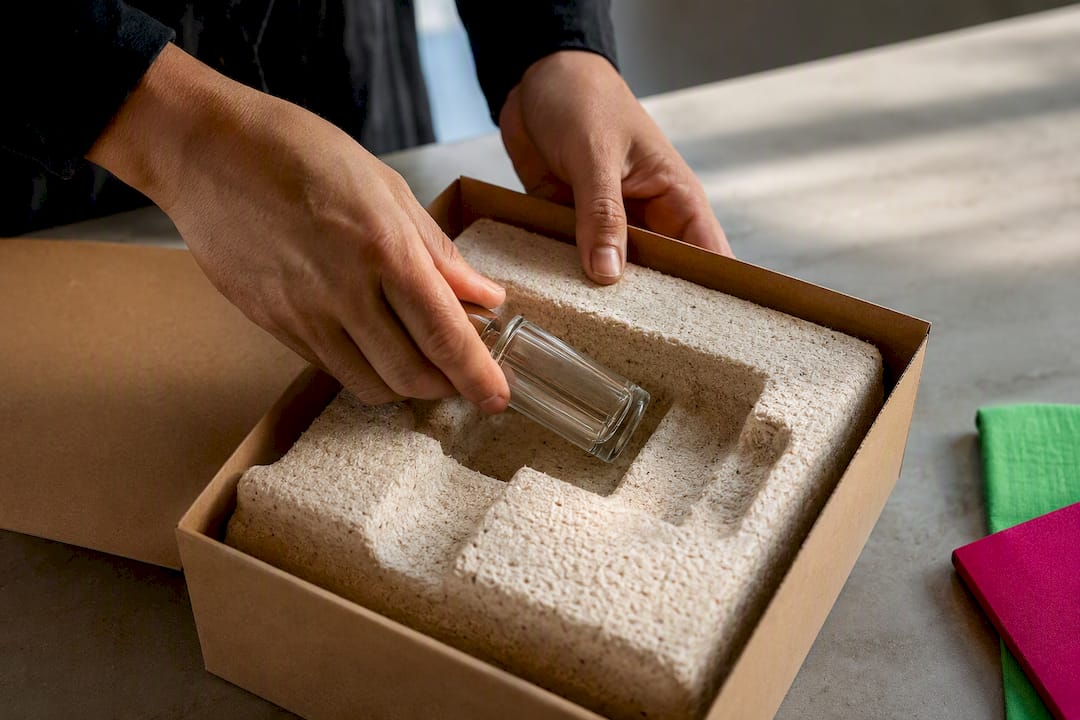
Precision-moulded pulp trays hold a bottle firmly in a fitted cavity, giving a crisp, structured look that reads as considered rather than raw. Mycelium clamshells go further: fragrance-specific trials found them shock-absorbent enough to protect glass through standard courier handling while composting fully at end of life, per the mycelium case study.
Getting there takes testing, not guesswork:
- Commission a prototype insert matched to the exact bottle weight and shape.
- Run repeated drop tests at courier-standard heights before finalising the mould.
- Check performance after humidity exposure, since pulp and mycelium behave differently in damp transit conditions than foam does.
- Ask the supplier directly what shock-absorption data exists for that specific material batch.
Pro Tip: Ask any pulp or mycelium supplier for their drop-test results at your bottle’s exact weight, not a generic spec sheet. Materials that protect a heavy 100ml flacon can fail on a lighter 30ml sample bottle, and vice versa.
Closures and pumps: where hidden plastic usually survives
Most “eco” perfume boxes still hide plastic in the one place buyers rarely check: the pump and collar. A crimped metal pump with a plastic actuator, glued permanently to the glass, sends the whole bottle to landfill because recycling facilities cannot separate mixed materials on a standard sorting line.
Genuinely plastic-free closures solve this through separability:
- Moulded pulp caps that unscrew or lift away cleanly from the neck.
- Wooden or metal caps fitted with a removable liner instead of a glued plastic seal.
- Refill systems, screw-in refills or atomiser cartridges, that eliminate the single-use pump altogether.
- A supplier checklist covering chemical compatibility, since perfume oils and alcohol can degrade some bio-based liners over months on a shelf.
Keeping the unboxing feeling premium without plastic
Dropping plastic does not mean dropping the experience of opening a beautifully made box.
- Choose paperboard finishes without a polyethylene laminate, since PE film is what stops a box composting or recycling cleanly even when the card itself is fine.
- Water-based inks and varnishes hold colour well and leave the paperboard fully compostable, unlike solvent-based coatings.
- Structural locks, folded tabs and shaped insert cavities can hold a bottle snugly without a single plastic clip, and ready-made biodegradable box formats already exist at commercial scale.
- The look and feel of the box often decides whether a customer keeps it as a keepsake or puts it straight in the recycling, so tactile finish is not a vanity detail.
Compostable, recyclable, or neither: reading the small print
Compostable and recyclable are not interchangeable claims, and mixing them up is where most greenwashing happens.
Industrial compostability requires facility conditions most councils do not offer, while home compostability means a garden compost heap will genuinely break the material down. A box marked “compostable” with no qualifier is worth a second look. Certifications worth trusting include ISCC PLUS for verified sustainable feedstock, FSC for responsibly sourced paper, and recognised compostability marks rather than a brand’s own green icon. Industry guidance on FSC, recycled paper and plastic-free options is a useful comparison point when weighing which certification actually matters for a given material.
- Separate pump, cap and box before disposal, since mixed items rarely get sorted correctly at kerb side recycling.
- Pulp and mycelium inserts usually go straight into home compost; plastic-coated card does not.
- Glass only recycles cleanly once every metal or plastic fitting has been removed.
Refillability is moving from a niche promise to a mainstream expectation in fragrance packaging, driven as much by EU packaging-waste policy as by customer demand.
A practical roadmap for brands switching to plastic-free packaging
Moving an existing product line off plastic is a sequencing problem more than a design one.
- Write a design brief that names separability as a requirement, not an aspiration, and lists exactly which materials and finishes are acceptable.
- Prototype early and test hard: budget several weeks for drop testing, humidity exposure and fragrance-compatibility checks before locking a mould.
- Choose suppliers with lifecycle strategies already proven, weighing a local pulp specialist’s smaller minimum order quantities against an overseas mycelium producer’s lower unit cost at volume.
- Set customer expectations honestly on pricing, since plastic-free components typically cost more per unit at low volume, and say so rather than burying it.
Pro Tip: Negotiate MOQ before you finalise design, not after. Many pulp and mycelium suppliers will lower minimum order quantities for a second production run once you have proven demand with a smaller first batch.
What Rookperfumes has learned making packaging decisions
Every packaging choice gets tested against the same question guiding this guide: does it separate, and does it compost or recycle without a caveat. Our discovery sample sets exist partly because smaller formats let us trial new pulp and closure options before committing a full bottle run to them, including releases like Undergrowth Eau de Parfum. Notes on why we chose the approach we did sit in our journal on building a perfume business and our guide to creating a fragrance.
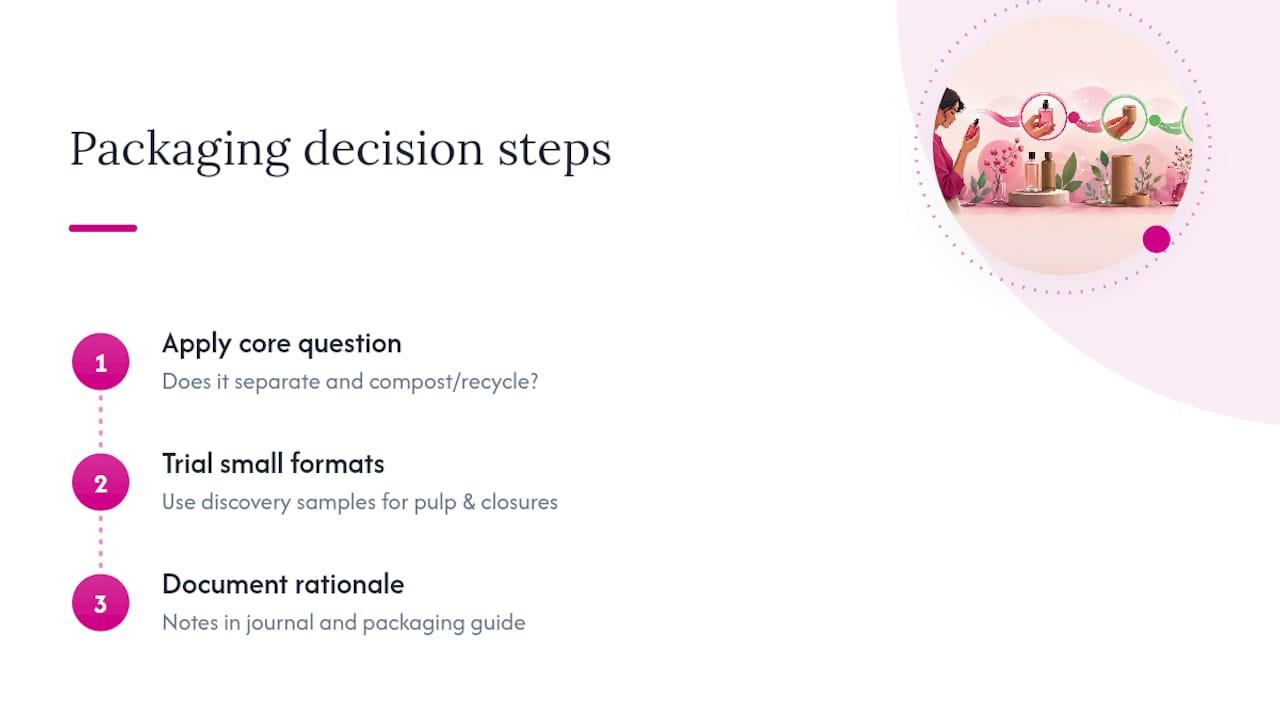
Why we accept the trade-offs
Plastic-free packaging costs more and takes longer to source, and we have made peace with both. A pulp cap that unscrews cleanly instead of a crimped plastic pump that seals in two seconds is a genuine compromise on speed and unit cost, but it is the only version of “sustainable” that survives contact with an actual recycling bin.
— Rook
Try plastic-free fragrance packaging for yourself
Rookperfumes builds every discovery format around the same principle covered in this guide: separable, low-waste packaging over single-use plastic. The Fragrance Discovery Sample Sets – £20–£30 Voucher Included let you test several scents in smaller formats before committing to a full bottle, reducing both financial risk and unnecessary packaging waste from an unwanted purchase.
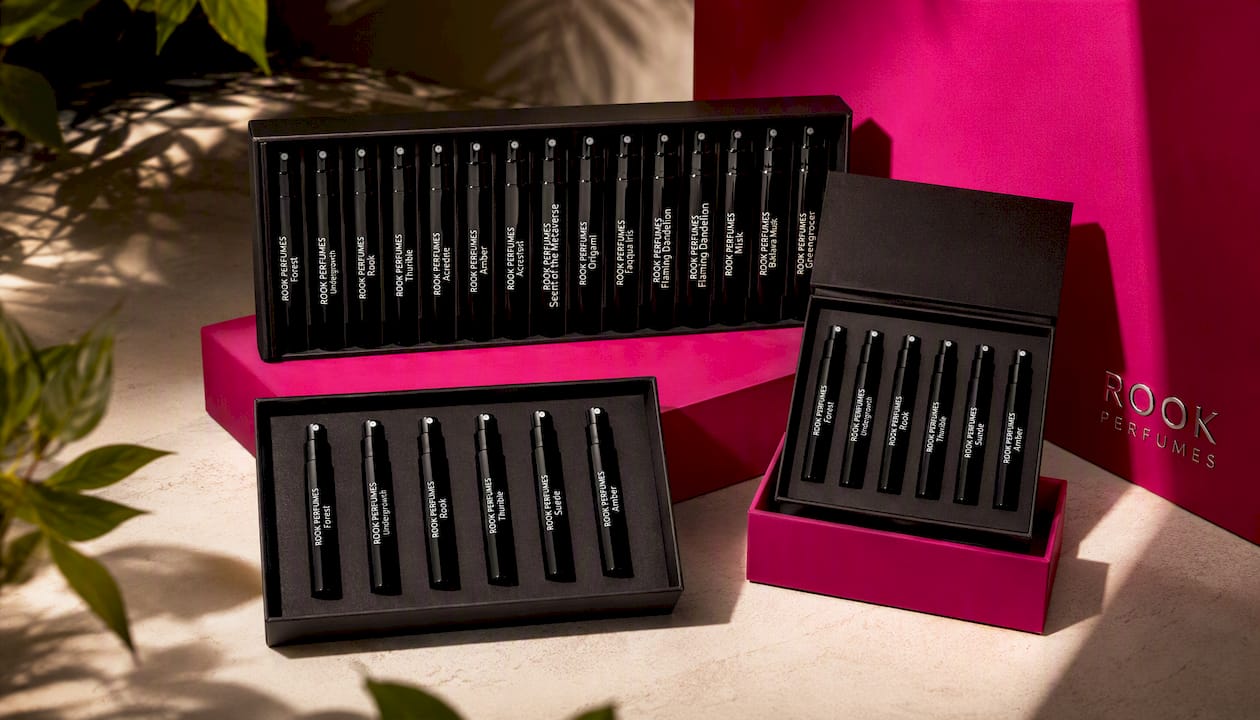
If you want a deeper session, THE FULL IMMERSION + £30 VOUCHER gives you a guided exploration alongside credit toward a future order, while THE INTRODUCTION SET + £20 VOUCHER suits anyone new to niche fragrance who wants a low-commitment starting point. Full bottles across Eau de Parfum, Parfum and Extrait, the story-driven Palestine Collection, and home scenting through Room Spray and Ambient Spray are all available once you have found a scent worth committing to. Pick a discovery set and see how a genuinely separable, low-waste format feels in hand.
Sources
- Sustainable perfume packaging trends
- Packaging waste — European Commission
- Case study: mycelium packaging for perfumes — S.Lab
- Chanel unveils N°1 de Chanel line featuring Sulapac’s biodegradable packaging
- Eco-friendly biodegradable moulded pulp perfume cap — Esen
FAQ
What counts as plastic free perfume packaging?
Plastic free means the bottle, closure, pump and box contain no conventional or bio-based plastic anywhere the customer handles them, not just a reduced amount. Genuine examples use moulded pulp, mycelium or certified paperboard with separable, non-plastic closures.
Is compostable packaging always better than recyclable packaging?
Not automatically. Industrial compostable packaging needs facility conditions most households cannot provide, while home compostable and cleanly recyclable glass or paperboard are usually the more reliable outcomes for typical customers.
How do I know a plastic-free claim isn’t greenwashing?
Look for a named certification such as ISCC PLUS or FSC rather than a brand’s own leaf icon, and check whether the pump, cap and box actually separate by hand. A claim with no certification and a glued-on plastic pump is worth doubting.
Does Rookperfumes use plastic-free packaging?
Rookperfumes designs its discovery sample sets and full-bottle releases with separability and lower-waste materials in mind, testing new formats through smaller batches first. Current packaging details for each product line are listed on the site itself.
What’s the biggest hidden source of plastic in perfume packaging?
The pump and collar mechanism, not the box. A crimped plastic pump glued permanently to a glass bottle is the single most common reason an otherwise paper-based package still fails to recycle.
0 kommenttia