

Most perfume bottles can be recycled, and you have three routes: kerbside glass collection, a bottle bank, a Household Waste Recycling Centre (HWRC), or a retailer take-back scheme. Empty the bottle, try to remove the pump if it comes off easily, then rinse it and check your council’s rules. If the glass is broken or the pump won’t budge, take it to an HWRC or a specialist retailer scheme instead.
TL;DR:
- Most perfume bottles can be recycled at home, but check local council rules since acceptance varies and some require removing pumps or caps beforehand.
- Head to bottle banks or HWRCs when kerbside collection is unavailable, bottles are broken, or pumps are attached, ensuring they are packaged safely for transport.
- Retailer take-back schemes and refill stations offer convenient ways to recycle or reuse perfume bottles, but always verify the store’s policies and pump removal requirements first.
- Removing spray pumps involves careful prying with tools, soaking in vinegar or alcohol if sticky, and thoroughly cleaning the bottle before recycling, with safety precautions in place.
- Reusing perfume bottles through upcycling or smaller formats is environmentally better than recycling, especially when you buy fewer full bottles and prefer sample sets or refill options.
Table of Contents
- Can you recycle perfume bottles at home in your glass bin?
- Bottle banks and HWRCs: when to skip the kerbside bin
- What retailer take-back and refill schemes actually offer
- How to remove a spray pump without wrecking the bottle
- Better than recycling: reuse and upcycle ideas
- How do you find your nearest recycling option fast?
- Consider buying less glass in the first place
- Try before you commit: a lower-waste way to shop for scent
- Sources
- FAQ
Can you recycle perfume bottles at home in your glass bin?
Perfume bottles are almost always made of glass, and glass is one of the most widely collected materials in household recycling. That’s good news if you’ve got a shelf of empties gathering dust. But acceptance isn’t automatic everywhere: some councils want the whole bottle, others insist the pump comes off first, and a few exclude small or awkward glass items altogether. Kent County Council’s waste guidance is a good example of how specific local rules can get, so check your own authority’s page before assuming.
Pro Tip: Keep a small box by your dressing table for empties. Batch them up and deal with the whole lot in one go rather than making separate trips for each bottle.
Preparing a bottle properly takes minutes:
- Tip out any residue and let the bottle air for a few hours so fumes don’t linger.
- Rinse with warm, soapy water; if the scent has left an oily film, a short soak in vinegar or rubbing alcohol lifts it faster.
- Remove the pump, cap, or any plastic collar if your council’s guidance asks for it.
- Never put broken glass in a kerbside bin, wrapped or not.
Recycle Now confirms that perfume and aftershave bottles are among the items people forget to recycle, even though they can be melted down and remade into new glass once they’re clean.
Bottle banks and HWRCs: when to skip the kerbside bin
Head to a bottle bank or HWRC when your council won’t take perfume bottles at the kerb, or when the spray pump simply refuses to come off. HWRCs tend to have more flexibility than kerbside collections because staff can sort awkward items by hand, and Merseyside Waste Disposal Authority’s HWRC guidance shows how these sites publish exactly what they’ll take, including mixed and sometimes broken glass, as long as it’s packaged safely.
A few things make the trip smoother:
- Cap the bottle if you can, then wrap it in newspaper or bubble wrap inside a sturdy box so it doesn’t shatter en route.
- If the glass is already broken, tell the site attendant when you arrive rather than tipping it loose into a skip.
- Mention any leftover residue so staff can direct you to the right bin.
- Call ahead if you’re unsure. Not every centre lists every rule online, and a two-minute phone call saves a wasted journey.
Bottle banks in car parks and supermarkets are usually for whole, unbroken glass only, so save the cracked ones for the HWRC.
What retailer take-back and refill schemes actually offer
Several high-street retailers run their own drop-off schemes for empty fragrance bottles, and a handful now offer refill stations for selected brands. Here’s what to expect from each:
- In-store drop-off schemes. Many stores accept empty perfume bottles regardless of which brand you bought, and some offer a small discount or voucher as a thank-you. The Perfume Shop’s own guidance confirms this is a genuine, if variable, incentive across retail take-back schemes.
- Refill stations. Less widespread, but a real low-waste option where they exist, letting you top up a bottle you already own instead of buying new glass each time.
- Beauty hall collection points. Some larger stores run periodic collection events tied to specific brands rather than a permanent scheme.
Always check the retailer’s website or ring the store first. Schemes change, some exclude broken glass entirely, and a few ask you to remove the pump before you hand the bottle over.
How to remove a spray pump without wrecking the bottle
Crimped spray pumps are the main obstacle to recycling perfume bottles cleanly, but they usually come off with the right tools and a bit of patience.
- Set up safely. Work on a stable surface with gloves and eye protection on. Flat glass necks can chip if pliers slip.
- Loosen the collar. Use flat-nose pliers to gently prise up the metal crimped collar around the base of the pump, working evenly around the edge rather than levering from one spot.
- Twist and pull. Once the collar lifts, twist the pump mechanism slightly and pull it straight up and out.
- Know when to stop. If it resists after a couple of careful attempts, don’t force it. Take the intact bottle to an HWRC or a retailer scheme that accepts pumps still attached.
Pro Tip: Soak stubborn, oily bottles in white vinegar or rubbing alcohol for 24 hours before you try to remove the pump. It loosens residue that otherwise gums up the mechanism.
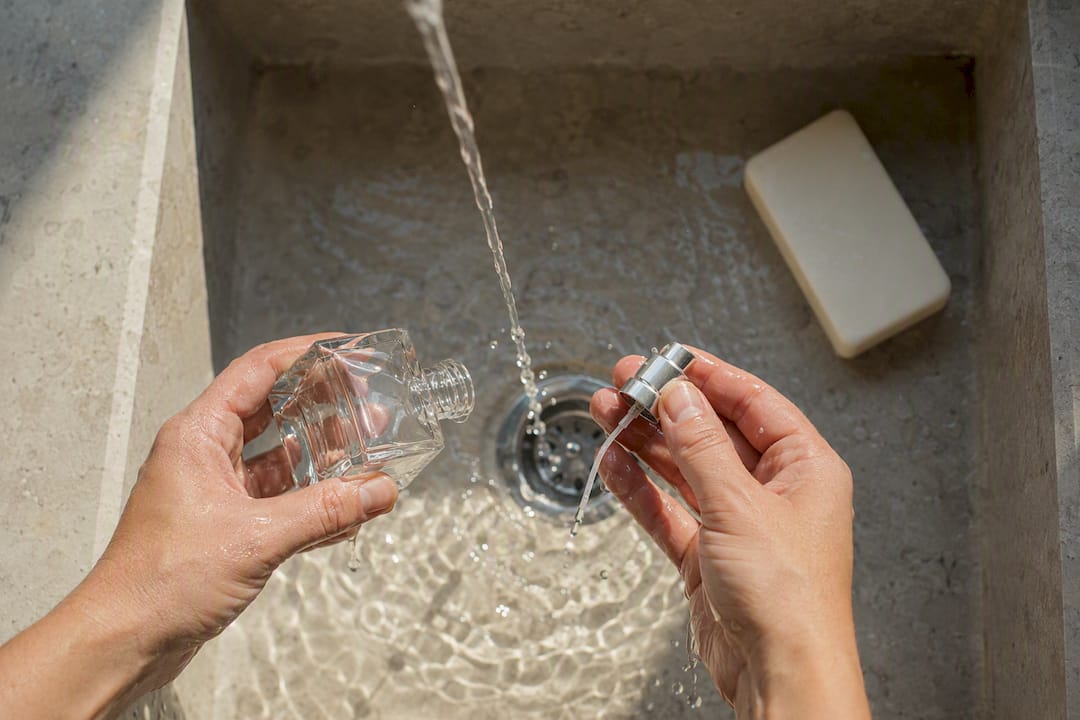
Once the pump’s out, wash the bottle in hot soapy water, rinse thoroughly, and let it dry completely before it goes anywhere near a recycling bin.
Better than recycling: reuse and upcycle ideas
Recycling melts glass back down, which uses energy. Reusing a bottle as it is skips that step entirely, and The Perfume Society actively encourages this before recycling, pointing out that a well-made flacon often has more life left in it than people assume.
Simple, low-effort options include:
- A travel atomiser for decanting your everyday scent into hand luggage.
- A linen spray bottle, refilled with a light water and essential oil mix.
- A reed diffuser vessel once the pump is removed and the neck is wide enough.
- A single-stem vase or shelf display piece, especially for sculptural bottles.
If you’re handy, upcycling into a small oil lamp or trinket holder is popular, though avoid putting a lit candle inside unless the glass is genuinely heatproof. And if the bottle is a rare or discontinued design, it might be worth more sold than reused. Practical UK guides on empty fragrance packaging note that collectors do pay for unusual flacons on resale sites, which keeps the glass in circulation rather than in a bin at all.
How do you find your nearest recycling option fast?
Checking local rules takes less time than most people expect:
- Search your council’s recycling page by postcode, or use Recycle Now’s locator to confirm what your area’s glass collection actually takes.
- Look up the retailer’s own recycling or sustainability page for the nearest in-store drop-off point or refill station.
- If a page is vague or out of date, ring the HWRC or store directly. Staff can usually confirm acceptance criteria in under a minute.
Consider buying less glass in the first place
The most sustainable bottle is the one you never had to recycle. Fewer bottles cluttering your shelves and, eventually, your bin, comes down to buying more deliberately in the first place. That’s the thinking behind offering discovery sample sets rather than pushing straight to a full bottle: try a scent properly before committing thirty or fifty millilitres of glass and liquid to something you might not wear past week two.
We build our fragrances with that same restraint, detailed in how we make a perfume. Where refill or smaller-format options exist, favour them. Where they don’t yet, buying only what you’ll actually finish is the next best habit.
— Rook
Try before you commit: a lower-waste way to shop for scent
Buying a full bottle on a hunch is how most unwanted glass ends up needing recycling in the first place. Rook Perfumes’ discovery sample sets let you test a handful of scents at once, so you commit to a full bottle only once you know it’s right.
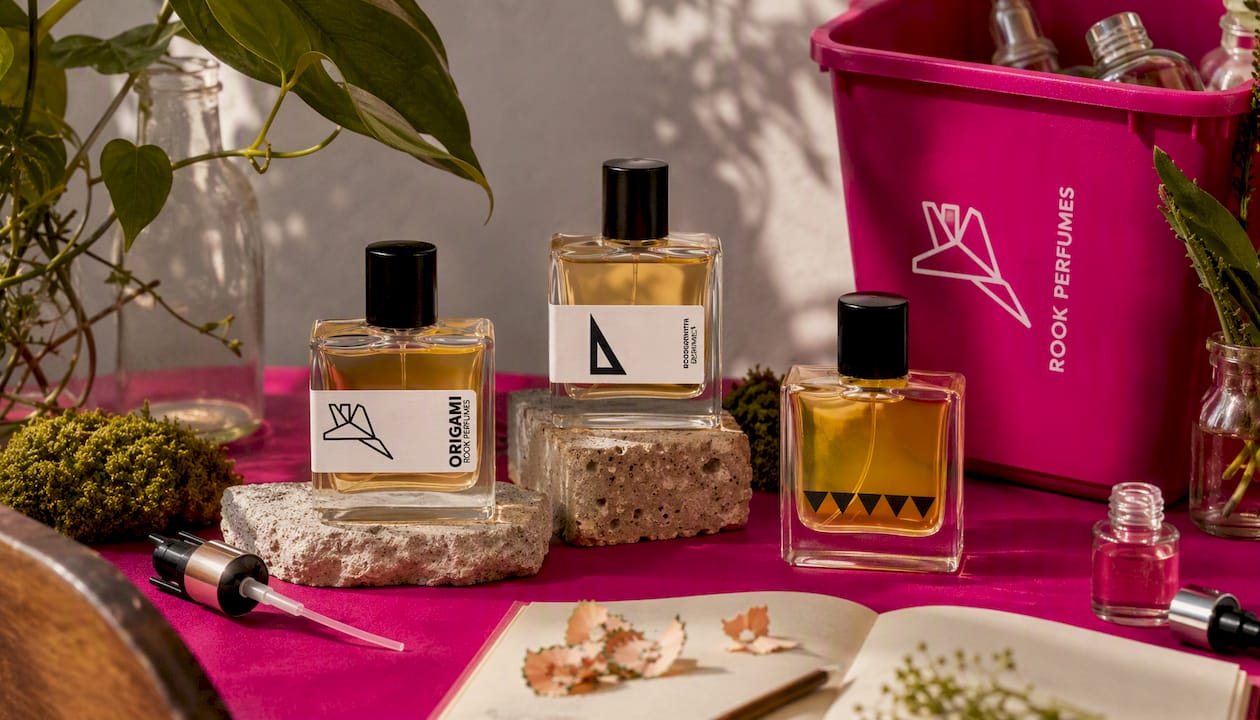
Once you’ve found a favourite, the catalogue includes options like the Origami Eau de Parfum in smokey matcha and cedar, the clearance-priced Undergrowth Eau de Parfum in greenery, earth and petrichor, and the nostalgic School Eau de Parfum, each unisex and cruelty-free. Start with a discovery set, find the one that lasts, and buy the bottle you’ll actually finish.
Sources
- Recycle Now — Glass bottles and jars
- Kent County Council: Rubbish and recycling – I want to get rid of
- How To Recycle Perfume Bottles | The Perfume Shop blog
- The Perfume Society — Too good to throw away: reusing & upcycling perfume bottles
FAQ
What do I do with my old perfume bottles?
Empty and rinse the bottle, remove the pump if it comes off easily, then recycle it via kerbside glass collection, a bottle bank, or an HWRC, or take it to a retailer with a drop-off scheme.
Do Boots recycling points accept perfume bottles?
Some high-street retailers run in-store take-back schemes for empty fragrance bottles, though participation and rewards vary by store, so check the retailer’s own page before visiting.
Are empty perfume bottles worth anything?
Most empties have no resale value, but rare, discontinued, or designer flacons can fetch money on resale sites, which is worth checking before you recycle a distinctive bottle.
Can I return empty perfume bottles to The Perfume Shop?
The Perfume Shop’s own guidance confirms it runs a take-back scheme for empty fragrance bottles, sometimes with a discount or voucher for returns, though it’s worth confirming current terms in-store first.
Is it better to reuse a perfume bottle than recycle it?
Reuse generally has a lighter environmental footprint than recycling, since it skips the energy needed to melt and remake glass, making a travel atomiser, vase, or diffuser vessel a better first option where the bottle allows it.
0 commentaire