

Start with samples, not a full bottle. Tomato leaf is a green, vegetal, occasionally peppery note that behaves unpredictably across formulations, so testing it on your own skin matters more than any review. Longevity varies widely depending on the composition, and Rookperfumes’ discovery sets are one direct route to trying it without committing.
TL;DR:
- Testing tomato leaf perfumes with discovery sets or small samples is essential, as longevity and scent development vary greatly depending on formulation.
- Authentic tomato leaf results in a green, slightly bitter, vegetal aroma that shifts quickly into floral or woody accords within minutes.
- Light, literal compositions last around three to four hours on skin, while richer, warmer blends with tonka or woody bases can last longer.
- Prices range from budget to high-end, but value depends on longevity and complexity rather than brand size, making discovery sets a smart choice.
- Genuine tomato leaf notes should smell green, sharp, and slightly peppery, with shifts over time, unlike synthetic or imitative scents that remain static or overly sweet.
Table of Contents
- What does tomato leaf perfume smell like?
- How do you sample tomato leaf perfumes before buying?
- How long do tomato leaf perfumes last, and how should you wear them?
- Why trust Rookperfumes on green, garden-inspired notes?
- What do tomato leaf perfumes cost, and are they worth it?
- How do you spot a genuine tomato leaf note versus a weak imitation?
- Which fragrance notes pair best with tomato leaf?
- When and where should you wear a tomato leaf perfume?
- A note from Rookperfumes on garden-green scents
- Try tomato leaf with Rookperfumes’ Undergrowth collection
- Sources
- FAQ
What does tomato leaf perfume smell like?
Snap a real tomato vine and you get the reference point: sharp, green, faintly peppery, with an acidic edge that sits somewhere between a crushed herb and sun-warmed greenhouse glass. That’s the character perfumers chase when they list “tomato leaf” on a pyramid. It isn’t sweet, it isn’t fruity, and it rarely stands alone for long. Most tomato leaf perfumes use it as an opening gesture, a green flash that fades into something softer within minutes.
The raw accord is intense, so perfumers almost always build supporting notes around it to make it wearable:
- Basil or mint — sharpens the green further and keeps it herbal rather than sweet
- Geranium — adds a rosy, slightly metallic lift that rounds off the rawness
- Apple or unripe green fruit — softens the vegetal edge without making it sugary
- Freesia or jasmine — brings a floral heart once the green top note settles
- Tonka or woody bases — grounds the composition and slows the fade, giving it a warm dry-down
Newer releases lean on this last strategy heavily. O Boticário’s 2024 Tomate, for instance, pairs tomato leaf with florals and tonka specifically to temper its green chord into something more gourmand-green and wearable, rather than leaving it aggressively vegetal throughout.
Why do perfumers reach for a note this difficult in the first place? Because it works as a memory trigger. Few smells conjure a specific place as reliably as crushed tomato vine. It’s a greenhouse, a grandparent’s allotment, a July afternoon. That specificity is exactly what makes it a favourite in narrative-driven niche fragrance, where the goal isn’t just to smell good but to summon a scene. Formulations vary a lot here, too. Natural tomato leaf extracts read greener and more literal; synthetic reconstructions can be smoothed out, made rounder, or pushed in a more abstract direction depending on what the perfumer wants the story to say.
How do you sample tomato leaf perfumes before buying?
You have more routes into this note than a single bottle purchase, and testing properly is the difference between loving it and regretting a full-size buy.
- Discovery sets — a handful of small vials or sprays from one house, letting you compare several green or herbaceous scents side by side before spending on a 50ml bottle.
- Single dropper or spray samples — cheap, low-commitment, and ideal if you already know which specific perfume you want to trial.
- In-store testing — still useful, though counter air rarely mimics how a scent behaves on warm skin over several hours.
- Fragrance oils — sold for candles and home scenting, these can be remarkably true to the fresh, crushed-leaf aroma, and they’re a fast way to learn what raw tomato vine smells like before you evaluate it inside a finished perfume.
- Room sprays and candles — a lower-stakes way to live with the note in your space before deciding it belongs on your skin.
Once you have a sample, test it properly. Spray it, then check it at three points: immediately, after ten to twenty minutes, and again after an hour, because the green top note in tomato leaf perfumes can be short-lived and the composition you smell at minute one is often gone by minute thirty. Apply it twice, on two different days if possible, since skin chemistry and humidity both shift how green notes read. If you’re genuinely curious how close a perfume gets to the source, crush a fresh tomato leaf and compare. Fragrantica’s community regularly points to Demeter’s Tomato as one of the most literal tomato-leaf interpretations going, and it’s a useful benchmark even if you never buy it, precisely because it doesn’t try to dress the note up.
Discovery sets remain the lowest-risk option of the lot. You’re not betting £70 or more on a note that some wearers find too sharp; you’re spending a fraction of that to find out how it sits on you specifically.
Pro Tip: If you’re testing a concentrated fragrance oil rather than a finished perfume, keep it off wood and painted surfaces. Undiluted oils can stain or damage certain finishes, so decant carefully and dilute before using it in any DIY project, following the IFRA guidance on handling concentrated aromatics if you’re formulating anything yourself.
How long do tomato leaf perfumes last, and how should you wear them?
Green notes are notoriously fickle on skin, so managing expectations early saves disappointment later.
Longevity varies widely by formulation. Lighter, more literal tomato-leaf compositions, the kind built to smell like the actual leaf, tend to last around three to four hours before fading close to skin. Richer niche versions, especially those anchored with warm bases like tonka, amber, or woody notes, can offer longer wear. Skin type, humidity, and how much product you apply all shift that range, so treat any stated longevity as a starting point rather than a guarantee.
To get the best out of a tomato leaf perfume:
- Layer for balance. Soft florals smooth the sharpness; a touch of citrus adds lift to the opening; warm bases like cedar or tonka extend the dry-down and stop the scent disappearing too fast.
- Apply to pulse points, not just clothing. Skin heat is what develops the heart and dry-down properly; fabric holds the top note longer but skips the transition.
- Reapply mid-afternoon if you’re wearing a lighter formulation and need it to survive an evening event.
- Test on your own skin chemistry before buying full size, since tomato leaf reads noticeably different from person to person.
- Moisturise unscented skin first. Dry skin burns through top notes faster; a barrier of lotion helps the green accord hold its shape longer.
- Decant into a travel spray so you can reapply without hauling a full bottle, particularly useful for a note that can fade before lunch.
If you want a warmer, easier-to-live-with version of this green family, The Greengrocer Eau de Parfum shows how peach and lily can soften a vegetal, almost industrial base note into something wearable across a full day.
Why trust Rookperfumes on green, garden-inspired notes?
The brand builds its fragrances on sustainable, cruelty-free practices and unisex formulations, an approach shared across every collection rather than reserved for one flagship scent. Green, earthy, memory-driven notes sit naturally within that ethos: they’re the kind of scent that tells a story rather than simply smelling pleasant. The brand’s own journal entry on its taste in niche perfumes sets out that thinking directly.
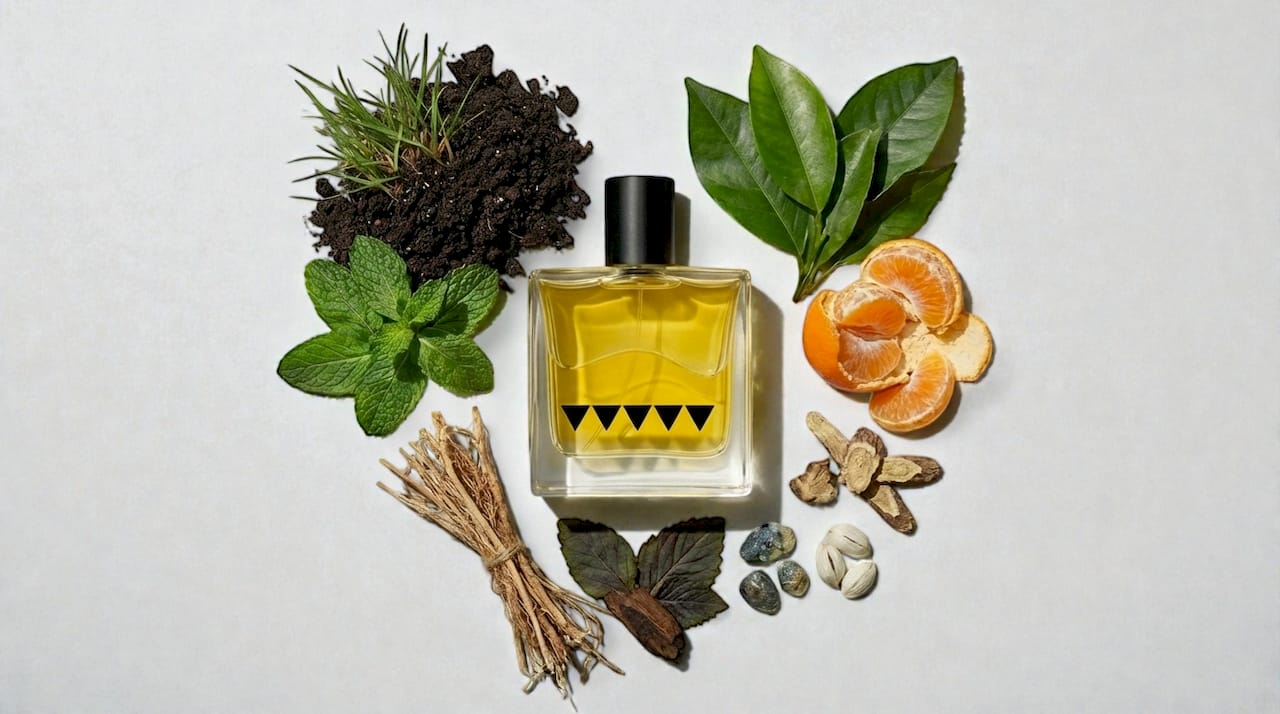
Discovery sets exist for exactly this reason. Green notes divide opinion more than most, so testing a small sample before buying a full bottle of something like Undergrowth Eau de Parfum removes the guesswork. You find out whether petrichor and greenery genuinely suit you, at a fraction of the cost of a wrong full-size purchase.
What do tomato leaf perfumes cost, and are they worth it?
Prices across the tomato-leaf category span a wide range, and the number on the box doesn’t always track quality. Mainstream, mass-market interpretations of the note sit at the cheaper end and tend to be simpler, one-dimensional green accords that fade within a few hours. Niche and independent houses charge more, generally because they’re using higher-quality raw materials, more complex supporting accords, and smaller production runs.
Editorial coverage has picked up on this too. Marie Claire’s roundup of tomato leaf fragrances specifically frames the note as one that reads as unexpected and “expensive” even at a mid-range price point, which tells you something about how the category is currently positioned: shoppers are paying for distinctiveness as much as raw ingredient cost.
Value, in this note specifically, comes down to longevity and complexity rather than brand size. A £30 tomato-leaf scent that fades in three hours isn’t necessarily worse value than a £120 bottle, if the £30 option does exactly what you wanted from it: a quick, memorable green burst rather than an all-day statement. The better question isn’t “what’s the most expensive option” but “how many wears will I actually get from this bottle, and does the dry-down suit me once the green fades.” Discovery sets let you answer that question for a few pounds rather than three figures, which matters more in this category than in almost any other, given how divisive raw green notes can be.
How do you spot a genuine tomato leaf note versus a weak imitation?
Not every perfume labelled “tomato leaf” delivers the same character, and knowing what to check for saves you from a disappointing purchase.
First, smell the opening critically. A genuine tomato-leaf accord should hit you as green, slightly bitter, and almost vegetal, closer to crushed foliage than to fruit. If what you’re smelling reads as sweet or fruity from the first spray, the tomato element is likely a minor supporting note rather than the star.
Second, check how it evolves. Authentic tomato-leaf compositions typically shift fast: sharp and raw at the opening, softening within ten to twenty minutes as the accord’s more volatile green molecules burn off. If a fragrance still smells identically “green” three hours in with no floral or woody development, that can actually signal a simpler, less nuanced construction, not necessarily a bad one, but worth knowing before you pay a premium for “complexity.”
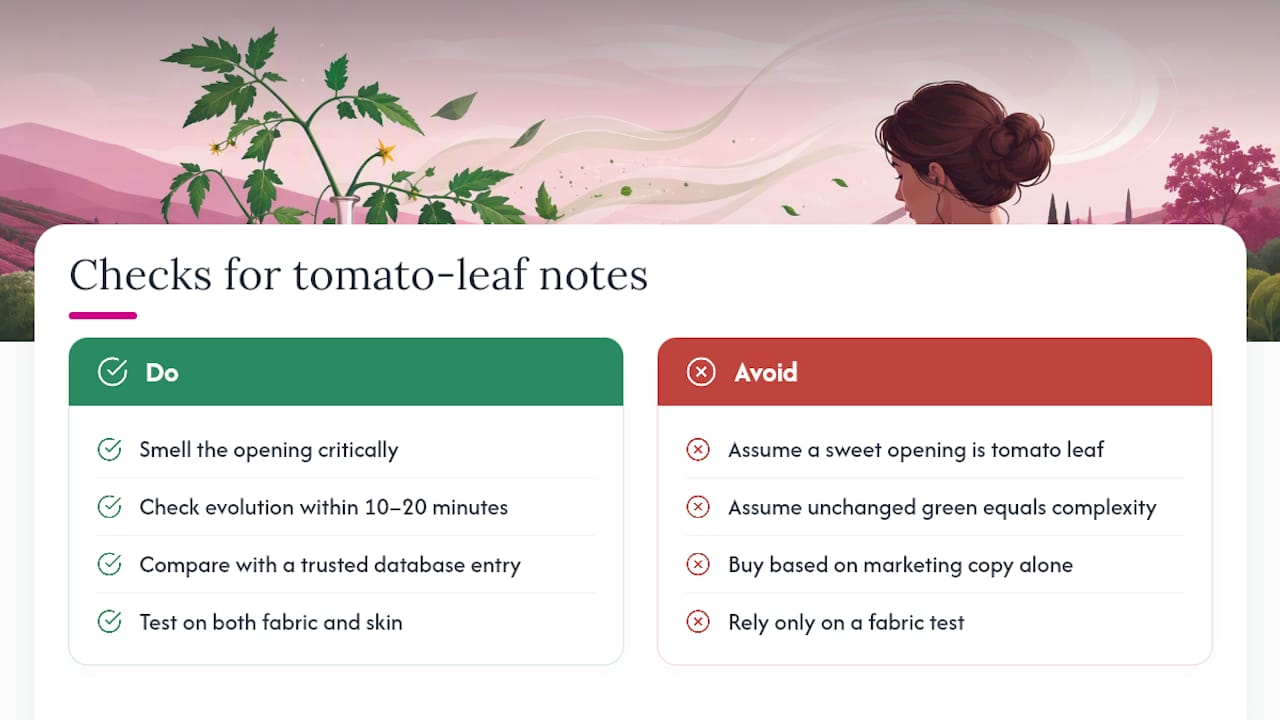
Third, cross-reference with a database entry you trust. Illuminum’s Tomato Leaf, for example, is documented as opening green and vegetal before moving into a floral heart and a musky, vanillic dry-down, which gives you a benchmark structure to compare against.
Finally, trust texture over marketing copy. Some practitioners test green notes by carrying a sample sprayed onto a scarf or fabric swatch, since tomato-leaf accords can read differently on textiles than on warm skin. If a “tomato leaf” perfume smells convincing on fabric but vanishes or turns synthetic-sharp on skin, that’s a useful, practical signal worth noting before you buy full size.
Which fragrance notes pair best with tomato leaf?
Tomato leaf rarely works well entirely on its own, it’s too sharp and too fleeting, so the combinations built around it matter more than the note itself.
Basil and mint are the most natural allies, doubling down on the green, herbal character and keeping the scent crisp and garden-fresh rather than letting it drift sweet. Geranium works differently: it adds a rosy, slightly metallic facet that rounds the rawness without softening the green identity entirely, a combination you’ll see in several niche releases aiming for a “cut stem” effect.
For wearers who find the pure accord too aggressive, florals like freesia or jasmine bridge the gap between green and gentle, giving the nose something softer to land on once the initial sharpness fades. Citrus, particularly bergamot or grapefruit, lifts the opening and adds sparkle without fighting the vegetal character.
The pairing that does the most work, though, is tomato leaf with warm base notes: tonka bean, cedar, or soft amber. Combining a sharp green top note with a warm gourmand base makes the whole composition far more approachable for anyone who finds raw green notes too austere, while still preserving the garden-fresh opening that makes tomato leaf distinctive in the first place. It’s the reason so many recent tomato-leaf releases lean top-heavy rather than leaving the green accord to stand alone.
When and where should you wear a tomato leaf perfume?
Tomato leaf reads as a warm-weather note more than anything else, and most wearers reach for it between late spring and early autumn. The green, sun-warmed character suits daytime wear particularly well: it feels appropriate for gardening, outdoor lunches, or simply days when a heavier, spicier fragrance would feel wrong against the heat.
That said, richer tomato-leaf compositions with tonka or woody bases can extend into cooler months without feeling out of place, especially for anyone who wants a signature scent that doesn’t shift with the seasons. The lighter, more literal interpretations, the ones that smell closest to actual crushed leaf, work best for casual, low-key occasions rather than formal evening wear. Save the tonka-heavy, more developed versions for situations where you want the scent to carry through a longer day or evening.
Office wear is generally safe territory too, since tomato leaf sits in a genuinely unisex register and rarely reads as overpowering the way some heavier floral or oud-based scents can in a closed room. If you’re choosing between multiple green fragrances for a specific event, lean literal and light for daytime, and warmer and more complex for anything after dark.
A note from Rookperfumes on garden-green scents
Green notes like tomato leaf resonate because they smell like a specific place, not just a pleasant abstraction. That’s the whole point of building fragrance around memory rather than trend. If you’ve never tried a garden-green scent, a discovery set costs far less than the regret of skipping it. Go smell one.
— Rook
Try tomato leaf with Rookperfumes’ Undergrowth collection
Rookperfumes is the direct route into this note for anyone who’d rather test a genuine green, earthy composition than gamble on a full bottle blind. Undergrowth Eau de Parfum 50ml, Greenery & Petrichor builds its story around damp foliage and rain-soaked earth, the same emotional territory as tomato leaf without needing to name the exact note, and it’s formulated cruelty-free and unisex, so it fits wearers of any background.
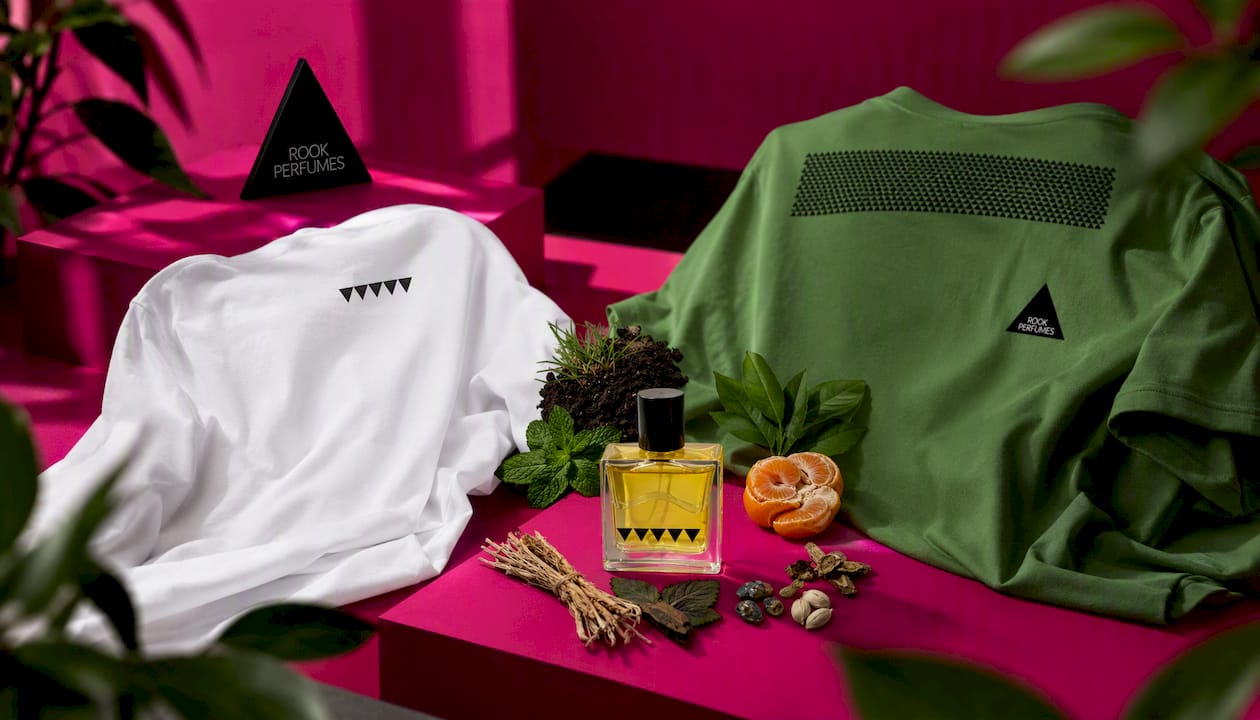
If the scent resonates, you can carry the story further than a bottle. The Undergrowth unisex t-shirt and the Forest unisex t-shirt extend the same green, garden-inspired narrative into wearable merchandise. For readers who want to explore more widely before settling on one bottle, the full Eau de Parfum, Parfum and Extrait range sits alongside the story-driven Palestine Collection, and anyone who’d rather live with a green scent in their space first can start with the Room Spray and Ambient Spray range. Start with a sample, and let your own skin decide.
Sources
For deeper verification, Fragrantica’s Demeter Tomato entry and IFRA UK offer useful starting points for the note’s character and formulation standards.
- Perfume: which fragrances Princess Diana and other royals were associated with
- Tomate O Boticário perfume - a fragrance for women and men 2024
- Tomato Leaf Illuminum (Eau de Parfum, 2011) - notes, accords & character
FAQ
What perfume smells like tomato leaves?
Demeter’s Tomato is widely cited as one of the most literal tomato-leaf interpretations available, giving a close approximation of crushed vine and leaf. Niche compositions like Illuminum’s Tomato Leaf and Rookperfumes’ Undergrowth take the note in a more layered, story-driven direction rather than a purely literal one.
What does a tomato leaf actually smell like?
Crushed tomato leaf smells green, sharp, and slightly peppery, with an acidic, almost sap-like edge closer to a garden herb than a fruit. Perfumers use this exact character as their reference when building a tomato-leaf accord.
Was Princess Diana’s favourite perfume a tomato leaf scent?
No. There’s no authoritative link between Princess Diana and tomato-leaf perfumes; tomato leaf is a modern niche trend rather than a documented royal signature scent.
What perfume did Kate Middleton wear on her wedding day?
Kate Middleton’s wedding-day fragrance is widely reported as Illuminum’s White Gardenia Petals, a floral gardenia composition unrelated to the tomato-leaf family.
How much do tomato leaf perfumes cost?
Prices vary widely across the tomato-leaf category, with mass-market interpretations typically cheaper and niche houses charging more for complex compositions. Rookperfumes doesn’t publish set prices online for its Eau de Parfum, Parfum, and Extrait lines, so current pricing is available directly on the perfumes collection page.
0 commentaire