

A campfire perfume blends smoky wood notes, such as guaiac and cedarwood, with warm gourmand or resinous base notes that stop the smoke reading as harsh or acrid. The best way to find your version is to sample several formats before buying a full bottle. This guide recommends starting with discovery sets as a low-risk way to sample smoky, unisex fragrances.
TL;DR:
- Sampling multiple formats, such as discovery sets and travel kits, helps identify the right smoky scent, as projection and longevity vary greatly.
- Natural smoke accords like guaiac and birch can feel rougher and more authentic, but synthetic options offer more consistent, linear aromas suitable for everyday wear.
- Concentration choice impacts performance: eau de parfum projects farther and lasts longer, while perfume oils suit closer, private application to soften harsh pyrogenic notes.
- Testing on skin and waiting for top notes to settle ensures an accurate impression, since smoky fragrances evolve significantly over an hour and overnight.
- Storage in a cool, dark place and avoiding heat or sunlight prolongs a smoky perfume’s freshness, while patch testing reduces skin irritation risks.
Table of Contents
- What does a campfire fragrance actually smell like?
- Curated picks: Rook’s campfire-adjacent fragrances
- How to choose the right campfire scent for you
- How to wear and layer smoky fragrances for best effect
- Why Rookperfumes and how discovery sets de-risk smoky scents
- Where campfire perfumes came from
- Natural woodsmoke versus synthetic smoky notes
- Skin sensitivities and allergies with smoky fragrances
- Storing campfire perfumes to protect the scent
- The emotional pull of campfire scents
- Try Rook’s campfire range before you commit to a bottle
- Sources
- FAQ
What does a campfire fragrance actually smell like?
A convincing campfire scent rarely smells like pure smoke. It smells like the memory of a fire: charred wood, cold ash, and something sweet drifting from the food someone toasted over it. Perfumers build that impression from a handful of recurring materials.
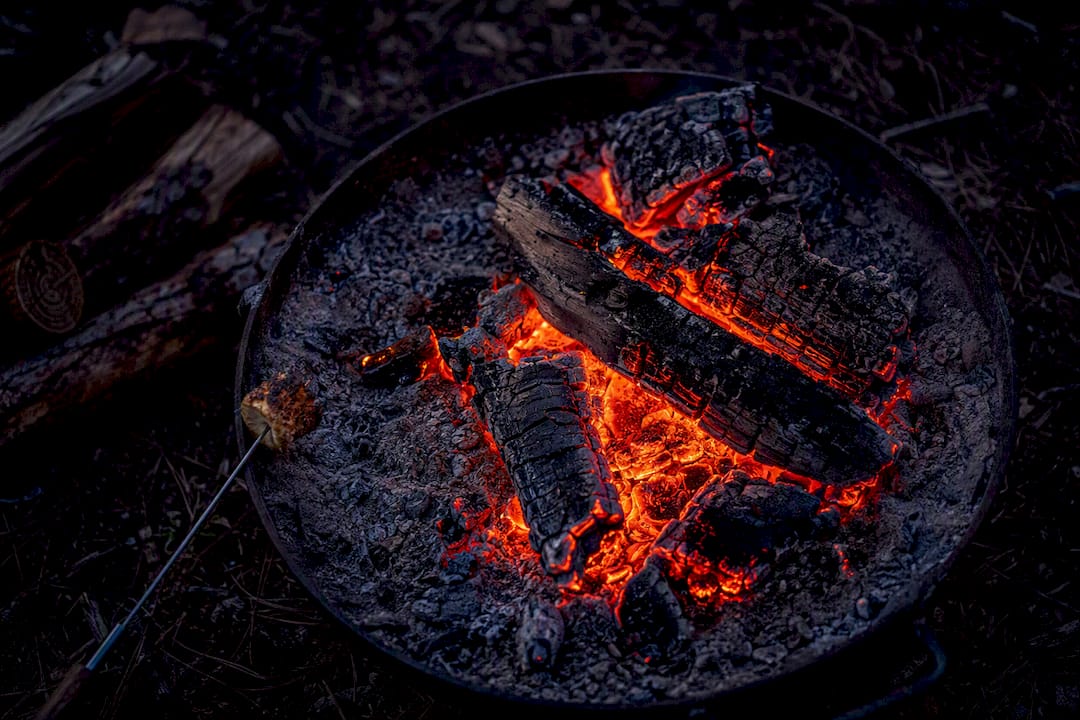
The smoky backbone usually comes from cedarwood, guaiac wood, and pyrogenic (burnt) accords, sometimes joined by birch tar or tobacco leaf for a rougher edge. Incense resins add a cooler, more ritualistic smoke, closer to a church or temple than a woodland clearing. On their own, these notes can smell severe, almost medicinal, which is why they rarely stand alone.
Warmth comes from the gourmand and resin side of the formula: roasted chestnut, maple sugar, vanilla, and Peru balsam are the usual suspects, and they’re the notes that stop a smoky perfume from smelling like a dying bonfire rather than a well-tended one. The Perfume Society’s seasonal guide points to this exact pairing of smoky woods with amber and vanilla as the classic autumn formula, while NewBeauty’s roundup of campfire scents highlights roasted chestnut specifically as a recurring gourmand partner.
A few things worth knowing before you sample:
- Note lists rarely show the full picture. Fragrantica’s breakdown of niche campfire-themed releases shows how top, heart, and base notes are structured in sequence, not blended flat, so the smoke you smell in the first five minutes often fades into something sweeter.
- Ambient oils differ from skin perfumes. A wax melt or room spray marketed as “campfire” is built to fill a space, not to interact with body chemistry, so it can smell far smokier on paper than a wearable eau de parfum with the same name.
- Outdoor functional sprays are a separate category. Products designed to freshen tents or outdoor gear, often built from cedarwood, lemon eucalyptus, and geranium, aim to mask odour rather than evoke nostalgia.
Curated picks: Rook’s campfire-adjacent fragrances
The range covers several ways smoke can read on skin, from sweet and toasted to austere and ritualistic, with a unisex approach to fragrance design.
- Flaming Dandelion Parfum leans gourmand ember: warm marshmallow against vetiver’s dry, earthy grip. It suits anyone who wants the “toasting food over the fire” side of the memory rather than the smoke itself.
- Acresford Eau de Parfum pairs smoky rose with cedar, a good pick for readers who find pure woodsmoke scents too austere and want a floral counterweight.
- Forest Eau de Parfum goes woodland-forward with pine and cedar, closer to standing near the woodpile than sitting at the fire itself.
- Rook Eau de Parfum is the boldest of the four: smoky incense and musk, built for wearers who want the ritual, temple-like side of smoke rather than the campsite side.
Because these sit in genuinely different corners of the campfire family, sampling before committing matters more than usual. The Fragrance Discovery Sample Sets, which come with a £20, £25 or £30 voucher (depending on the set) toward a full bottle, let you compare two or three smoky directions side by side without guessing from a notes list alone.
| Pick | Best for | Standout note |
|---|---|---|
| Flaming Dandelion Parfum | Sweet, toasted gourmand lovers | Warm marshmallow |
| Acresford Eau de Parfum | Readers who want smoke softened by florals | Smoky rose |
| Forest Eau de Parfum | Wood-forward, outdoorsy wearers | Pine and cedar |
| Rook Eau de Parfum | Bold, incense-leaning wearers | Smokey incense and musk |
How to choose the right campfire scent for you
Concentration matters more with smoky fragrances than with most other families. An eau de parfum projects further and lasts longer, which suits a dry, resinous scent that needs distance to soften. A perfume oil sits closer to the skin from the start, which is often kinder to sharp pyrogenic notes that can smell harsh at full strength straight from the bottle, a point makers of alcohol-free campfire perfume oils lean on directly when marketing their maple sugar and charred marshmallow blends.
When you’re trying samples, work through this sequence rather than judging on first spray:
- Apply to skin, not just a card, since smoke accords behave differently against body chemistry.
- Wait for the sharpest top notes to settle before judging the scent, since the first impression of a smoky fragrance is rarely its final character.
- Note how far the scent projects after an hour. A campfire scent that’s too loud in a meeting room might be exactly right for a solo autumn walk.
- Check how it reads the next morning on unwashed skin. Base notes like guaiac and vanilla often reveal themselves only at this stage.
Watch for vague description phrases like “smoky blend” or “bonfire vibes” with no named materials. That usually means the composition leans on a single synthetic pyrogenic accord rather than the layered wood-and-resin structure that makes campfire scents work.
Pro Tip: Test a smoky fragrance on a day you’re not wearing anything scented on your clothes or hair. Smoke accords cling to fabric fast, and yesterday’s perfume will muddy your read on today’s sample.
How to wear and layer smoky fragrances for best effect
Pulse points still work for campfire scents, but placement changes the effect. Wrists and the inside of the elbow give you a scent you catch when you move your hands, which suits an oil-based smoky fragrance you want to notice privately through the day. Spraying at the collarbone and hair projects the scent outward, better suited to a bolder eau de parfum like an incense-forward pick.
Longevity comes from what’s underneath the fragrance, not just what’s in the bottle. Applying a smoky perfume over an unscented balm or oil-based moisturiser slows evaporation and helps base notes like guaiac and Peru balsam last into the evening rather than burning off in the first hour. A light spritz on clothing, away from delicate fabrics, extends the aura further than skin application alone.
- Layer a light woody base (Forest Eau de Parfum, for instance) with a sweeter gourmand top spray for a fire-with-food effect.
- Always patch test a new smoky fragrance on the inside of your forearm 24 hours before wearing it properly.
- Reapply from a travel atomiser mid-afternoon rather than doubling up in the morning, since smoke accords can turn ashy if overdosed.
Pro Tip: If a campfire scent smells too aggressive on first application, wait ten minutes before writing it off. Guaiac and birch notes often soften considerably as they meet skin warmth.
Why Rookperfumes and how discovery sets de-risk smoky scents
Rookperfumes builds every fragrance, campfire-inspired or otherwise, on the same principles: cruelty-free formulation, sustainable practices, and unisex design that doesn’t force smoky scents into a “masculine” box, which is where many mainstream ranges still park them.
The brand’s approach goes beyond scent alone. Its ‘Scent for Gaza’ release ties a fragrance directly to a cultural and social narrative, treating perfume as a storytelling medium rather than a purely commercial product. That same memory-inspired philosophy runs through the smoky range, from Flaming Dandelion’s marshmallow warmth to Rook’s incense-heavy signature.
- Cruelty-free, unisex formulation across the entire smoky and gourmand range.
- Advocacy-driven releases that link scent to real narratives, not just marketing copy.
- Artistic, niche compositions built to challenge mainstream fragrance conventions.
- Discovery sets that let you test smoky accords risk-free before buying a full bottle.
Where campfire perfumes came from
Smoke as a fragrance material predates modern perfumery by millennia. Incense resins, frankincense and myrrh among them, were burned in religious ritual long before anyone bottled them into wearable scent, and that ritual association still colours how incense-forward “campfire” perfumes read today: closer to temple than tent.
The wearable version of a campfire scent, built around wood smoke rather than resin smoke, is a much more recent invention. It tracks fairly closely with the wider rise of “gourmand” and “cosy” fragrance categories over the past two decades, as perfumers moved away from clean florals and aquatics toward scents that mimic comfort foods, warm drinks, and open fires. The Perfume Society’s framing of smoky scents as a specifically autumnal, Bonfire Night category shows how firmly this has become a seasonal ritual in its own right, a way to mark the shift from light summer scents to something grounded.
Culturally, the appeal sits somewhere between nostalgia and comfort. A fire has meant safety, food, and gathering for most of human history, so a scent that recalls one taps into something older than fashion. That’s likely why campfire perfumes cluster so heavily around autumn and winter releases rather than appearing year round: they’re doing emotional work tied to a season, not just filling a niche category on a shelf.
Natural woodsmoke versus synthetic smoky notes
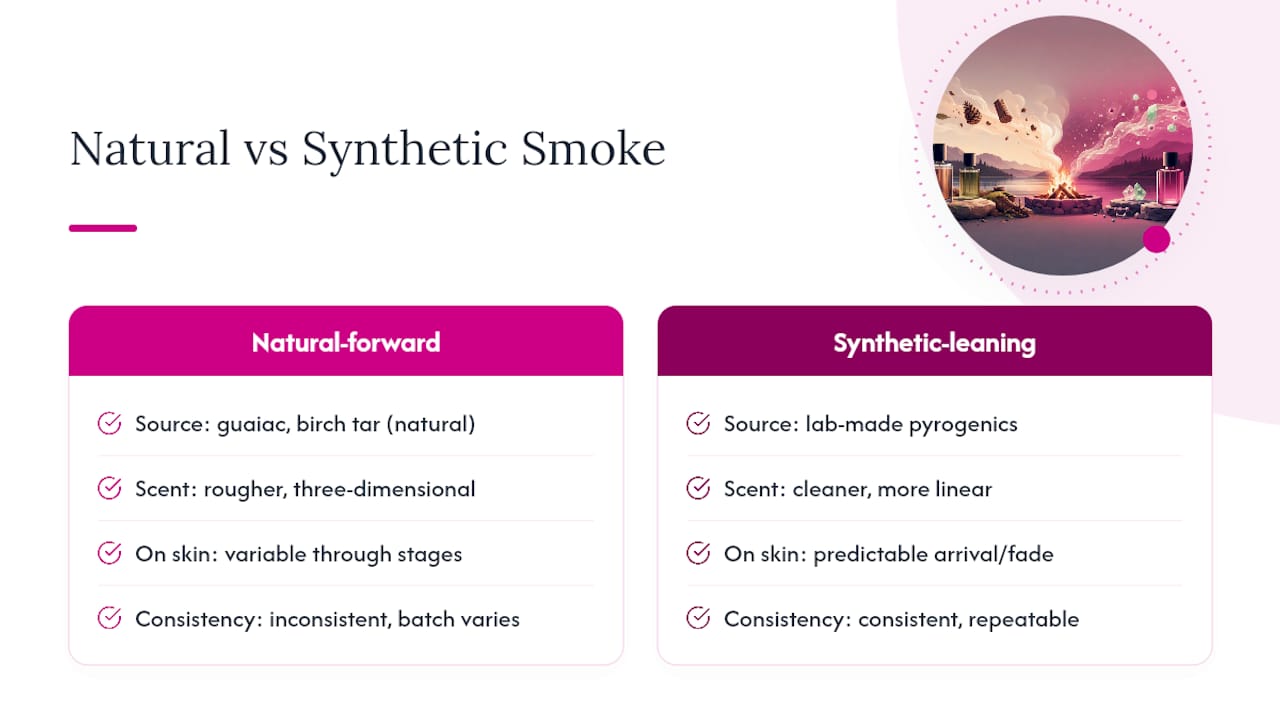
Real woodsmoke and burnt leaves smell complex and slightly unstable, changing character depending on what’s burning, how damp the wood is, and how much char versus ember is in the mix. Capturing that instability in a bottle is difficult, because natural smoke extracts are expensive, inconsistent, and often too harsh to wear directly on skin.
Most commercial campfire perfumes rely instead on synthetic or semi-synthetic pyrogenic materials engineered to mimic smoke without the instability. Guaiac wood and birch tar are natural in origin but heavily processed to isolate the smoky facets perfumers want, while purely synthetic “smoke” accords are built in a lab to hit a consistent, repeatable character batch after batch.
The practical difference shows up on skin. A synthetic smoky accord tends to smell cleaner and more linear, arriving and fading in a predictable arc. A composition built around natural guaiac or birch tends to feel rougher and more three-dimensional, with more variation as it moves through top, heart, and base. Neither is inherently better. A synthetic-leaning composition suits someone who wants a reliable, wearable version of “campfire” for everyday use, while a natural-forward one suits someone chasing a rawer, more authentic burnt-wood impression, closer to standing near an actual fire.
Skin sensitivities and allergies with smoky fragrances
Smoky and woody fragrance materials sit among the more commonly flagged allergens in perfumery. Birch tar and certain guaiac derivatives can cause contact sensitivity in people prone to fragrance allergies, and the sharp, phenolic character of some pyrogenic accords makes them more likely to trigger irritation than softer floral or citrus notes.
Gourmand and resin components carry their own risks. Vanilla and balsam-type materials are generally well tolerated but can cause reactions in people sensitive to Peru balsam specifically, a known contact allergen. Anyone with a history of fragrance sensitivity, eczema, or contact dermatitis should treat a new smoky perfume the way they’d treat any new skincare product: patch test first.
The practical fix is straightforward. Apply a small amount to the inside of your forearm, wait 24 hours, and check for redness, itching, or irritation before spraying it more widely. If you already know you react to specific materials, check the notes list before buying rather than after, since smoky fragrances lean on a narrower set of core ingredients (cedarwood, guaiac, birch, resins) than most other families, which makes it easier to spot a likely trigger in advance. Anyone with diagnosed fragrance allergies should raise concerns with a pharmacist or GP before introducing a new smoky scent into daily wear.
Storing campfire perfumes to protect the scent
Smoky and resinous fragrances are more heat-sensitive than most, because the same warmth that makes an eau de parfum “bloom” on skin can also degrade guaiac, birch, and resin molecules faster in the bottle. Direct sunlight and bathroom humidity are the two worst environments for any perfume, and campfire-style compositions lose their edge in both faster than lighter florals or citrus scents.
Keep bottles in a cool, dark place, ideally in the original box, away from radiators, windowsills, and steamy bathroom cabinets. A bedroom drawer or a dedicated perfume box out of direct light works better than a bathroom shelf, however convenient the shelf might be.
Travel atomisers deserve particular care. Because they’re refilled and carried loose in bags, they’re more exposed to temperature swings than a full bottle sitting in a cupboard. Decant only what you’ll use within a few weeks, and avoid leaving a filled atomiser in a hot car or direct sun, which can noticeably flatten a smoky composition’s top notes within days.
The emotional pull of campfire scents
Smoke is one of the few notes that reads as memory before it reads as fragrance. It’s why Rook builds warmth into every smoky formula rather than letting the char dominate: harsh smoke reads as fire damage, balanced smoke reads as an evening you want to remember. If any of the picks above caught your attention, a discovery set is the honest way to find out which balance suits you.
— Rook
Try Rook’s campfire range before you commit to a bottle
Sampling is the only reliable way to know how a smoky fragrance will actually behave on your skin, and Rookperfumes builds its entire discovery model around exactly that problem: no guessing from a notes list, no expensive mistake on a full bottle.
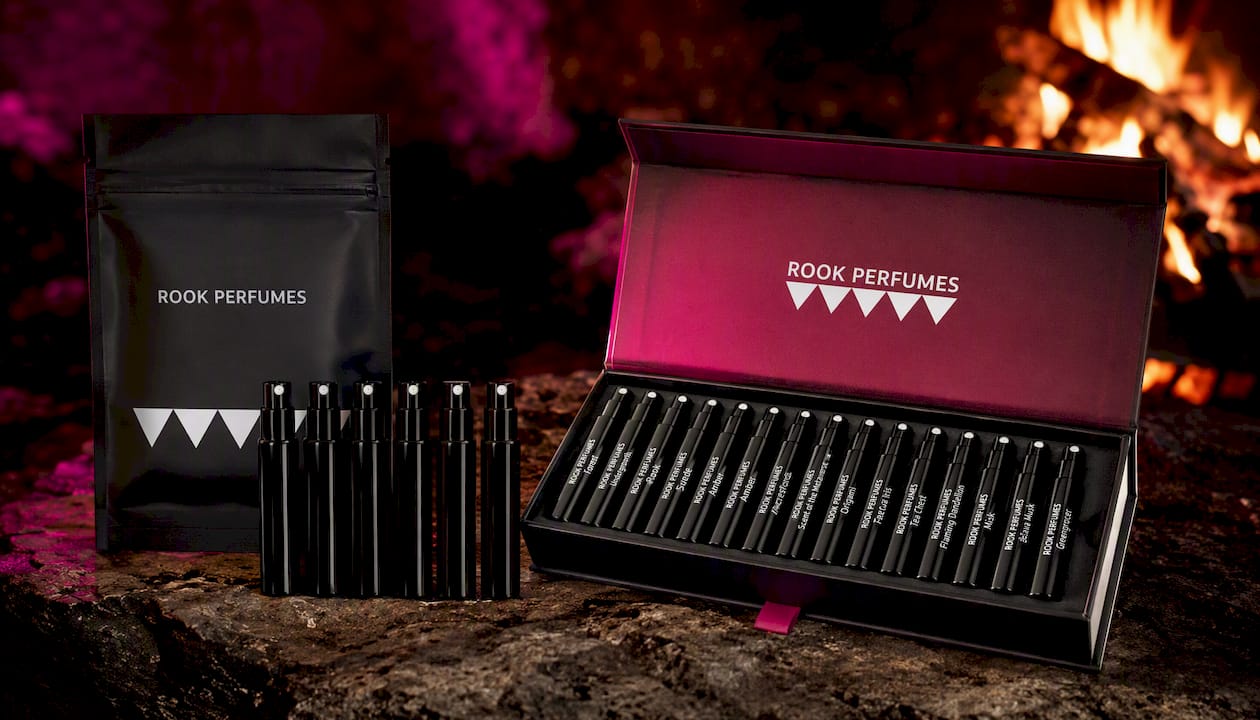
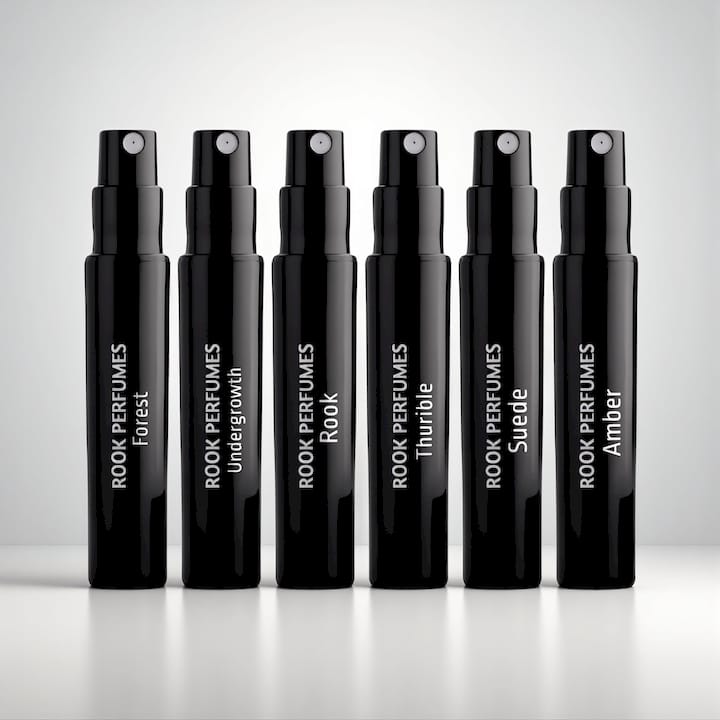
Three routes suit three different levels of curiosity. If you want to compare a handful of scents side by side, start with the Fragrance Discovery Sample Sets, which include a £20, £25 or £30 voucher (depending on the set) toward a full bottle once you’ve found your match. If you travel often or want pocket-sized testers for a weekend away or a night by an actual fire, the Travel Sets with 6 x 3ml atomisers let you carry several smoky options at once. And if you’re ready for a deeper exploration across the full range, The Full Immersion comes with a £30 voucher and gives you the widest possible spread before choosing your signature scent. Pick the option that matches how committed you already feel, and start there.
Sources
- Smoky scents for Bonfire Night (& beyond) — The Perfume Society
- Take the summer bonfire with you: 10 irresistible campfire scents for fall — NewBeauty
- Factory Edition: Camp Fire — Fragrantica
FAQ
What perfume smells like a campfire?
Fragrances built around cedarwood, guaiac wood, and birch tar, often paired with vanilla or roasted chestnut, tend to smell closest to a real campfire. Rookperfumes’ Rook Eau de Parfum and Flaming Dandelion Parfum both sit in this family, one leaning incense-smoky, the other toasted and gourmand.
What does a campfire actually smell like in fragrance terms?
A real campfire smells like a mix of charred wood, cold ash, and whatever’s cooking over it, which is why perfumers combine smoky woods (guaiac, cedarwood) with warm gourmand notes like maple sugar or vanilla rather than using smoke alone.
Is a perfume oil or spray better for a smoky scent?
Perfume oils sit closer to the skin and can soften sharp pyrogenic notes better than a full-strength spray, making them a good entry point for anyone new to smoky fragrances. An eau de parfum projects further, which suits wearers who want the scent noticed from a distance.
How long should I wait before judging a campfire fragrance sample?
Apply it to skin rather than a card and give the top notes time to settle before forming a judgement, since the first impression of a smoky fragrance rarely matches how it smells an hour later.
Can smoky fragrance notes cause skin irritation?
Yes. Birch tar, certain guaiac derivatives, and balsam-type materials are known to trigger contact sensitivity in some people, so patch testing on the forearm 24 hours before full wear is worth doing with any new smoky perfume.
0 commenti