

Your skin doesn’t perform alchemy on a perfume. Oiliness, warmth and hydration change how quickly fragrance molecules evaporate, which shifts what you smell and when. Genuine chemical transformation is rare on clean, dry skin. The differences you notice between your wrist and your friend’s are mostly about evaporation speed and which notes get emphasised, not a mysterious reaction unique to you. Test on your own skin and you’ll know exactly what to expect.
TL;DR:
- Oily skin prolongs perfume wear and enhances base notes by acting as a reservoir, while dry skin causes faster evaporation and a shorter scent lifespan.
- Body warmth speeds up evaporation, leading to stronger initial projection but reduced overall longevity, especially on hot days or after exercise.
- Hydration significantly impacts scent longevity; applying unscented moisturizer before perfume helps molecules bind and extends wear time.
- The microflora on the skin minimally affect scent evolution, except in occluded areas like the underarms, which host bacteria that can influence odor.
- Proper testing involves wearing perfume over several days, on pulse points and clothing, and comparing skin versus fabric application to accurately assess performance.
Table of Contents
- What actually changes when perfume meets your skin
- How to test a perfume on your skin properly
- Simple adjustments that improve longevity and balance
- Notes from Rook: how a perfumer actually tests a scent
- Is “skin chemistry” even the right way to think about this?
- Try it on your own skin before you commit
- Sources
- FAQ
What actually changes when perfume meets your skin
A perfume is built in layers, usually described as top, heart and base notes, each evaporating at a different rate. Top notes vanish within minutes. Heart notes carry the scent through the middle hours. Base notes linger longer because their molecules are heavier and slower to release. Skin doesn’t rewrite this structure. It changes the timing.
Oiliness is the biggest lever. Sebum acts as a reservoir. Fragrance molecules, particularly the heavier base-note materials like amber, musk and resins, dissolve into that oil and release gradually rather than all at once. That’s why oily skin often makes a perfume last longer and can push base notes forward earlier than the perfumer intended. Dry skin does the opposite: without oil to slow things down, top and heart notes burn off faster, and the whole composition can feel thinner and shorter-lived.
Body temperature matters almost as much. Warmer skin, and the pulse points sit above arteries close to the surface for exactly this reason, speeds up evaporation. That gives you a stronger, more immediate projection in the first half hour, but it can shorten total wear time because the fragrance is simply burning through its top and heart notes at a faster clip. Higher skin temperature reliably increases volatility, which is why a perfume applied on a hot day or after exercise reads louder but fades quicker than the same spray on cool, calm skin, according to research on how personal care products interact with skin surface chemistry.
Hydration is the easiest variable to control. Dry, flaky skin has less surface moisture and, often, less natural oil, so fragrance evaporates almost as soon as it lands. An unscented moisturiser applied beforehand gives molecules something to bind to, similar to the reservoir effect of natural sebum, and it’s the single most reliable fix for anyone who feels their scent “disappears” within an hour.
The skin microbiome plays a smaller and more localised role than marketing copy suggests. Underarm skin, warm, moist and occluded, hosts bacteria that can interact with sweat and fragrance compounds in ways that alter odour, but this is a specific, contained effect rather than a whole-body chemical rewrite. Elsewhere on the body, in drier, better-ventilated areas like the forearm or décolletage, microbial influence on scent is minimal.
Skin pH gets blamed constantly and deserves less credit than it gets. Healthy skin sits in a fairly narrow band, and that range doesn’t vary enough between individuals to meaningfully change how a fragrance smells. pH becomes relevant only when the skin barrier itself is disrupted, through eczema, over-exfoliation or harsh soap, which can alter surface chemistry and, in turn, how products sit on the skin.
A study using headspace and solvent swabbing techniques found that most of what changes between skin and perfume is physical, evaporation and absorption, rather than chemical. Meaningful chemical transformation was low on clean, dry skin, with microbial effects showing up mainly in occluded zones like the underarm, according to research examining physical and chemical interactions between skin and perfume.
That distinction matters for how you think about the whole topic. You’re not dealing with a personal chemical reaction that makes fragrances “wrong” for you. You’re dealing with a small set of physical variables, oil, heat, moisture, that you can actually observe and adjust.
- Oily skin: slower evaporation, longer wear, stronger base notes
- Dry skin: faster evaporation, shorter wear, weaker projection over time
- Warm skin/pulse points: stronger initial projection, potentially shorter total duration
- Occluded, moist zones (underarms): the only area with meaningful microbial influence on scent
- Normal skin pH range: negligible effect unless the skin barrier is compromised
How to test a perfume on your skin properly
Most people judge a fragrance by spraying a card in a shop and sniffing it thirty seconds later. That tells you almost nothing about how it will behave on you. A proper wear test takes a few days, not a few seconds, and it’s the only method that accounts for your specific combination of oil, warmth and hydration.
- Spray on skin, not a test strip. Apply one spray to a clean pulse point, usually the inner wrist or forearm, and resist the urge to rub it in. Rubbing crushes the top-note structure and can push the fragrance to evaporate unevenly.
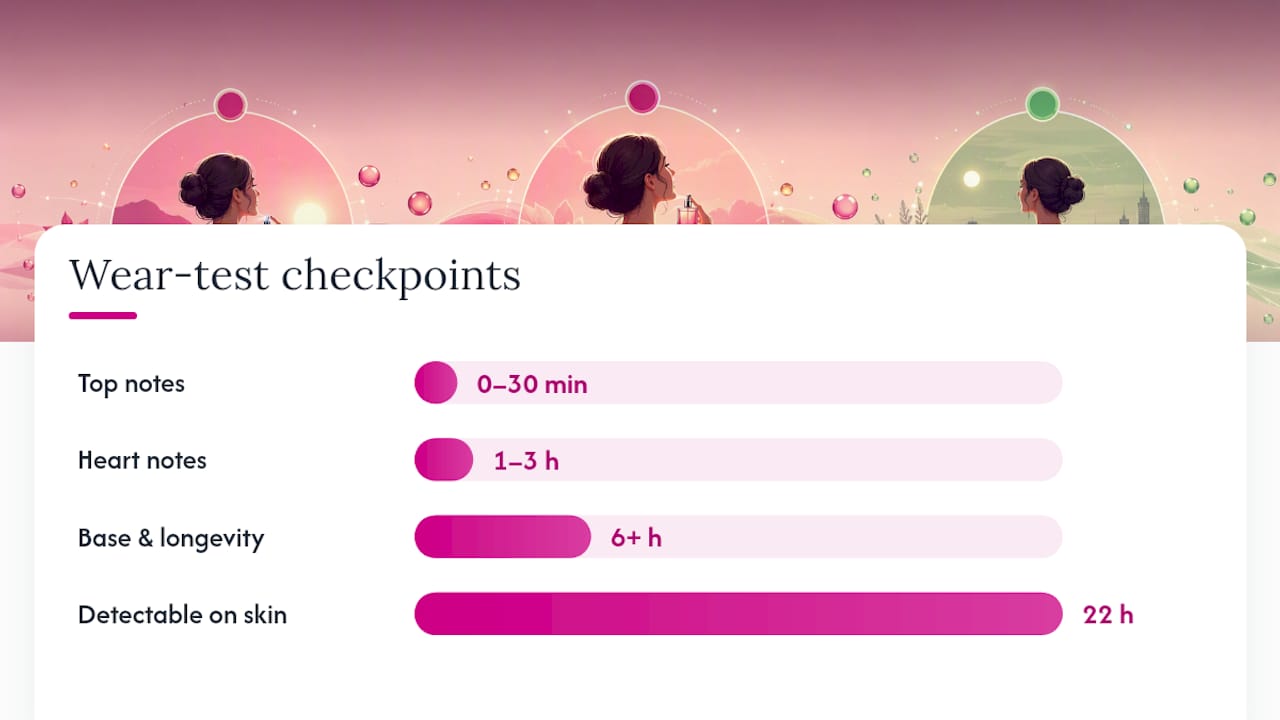
- Log it at three checkpoints. Smell it at 0 to 30 minutes to catch the top notes, again at 1 to 3 hours for the heart, and once more at 6 hours or later to judge the base and overall longevity.
- Keep everything else constant. Wear it on a day when you haven’t changed body lotion, laundry detergent or deodorant, since those products genuinely interact with fragrance on skin, according to the same research on personal care product interactions cited above. Alcohol intake, medication and even diet can shift how sweat smells, which then layers with the perfume.
- Test skin against fabric separately. Spray a small amount on a plain cotton swatch and compare it to the skin version at the same time intervals. If the fabric version smells markedly different from the skin version, you’re looking at a genuine skin effect rather than the formula’s natural evolution.
- Repeat at least twice before deciding. One wear can be thrown off by an unusually hot day, a new soap, or simple inattention. Two or three wears, logged briefly, give you a pattern you can trust.
A simple diary, even three lines per wear, is worth more than a first impression. Note the date, what else you applied to your skin that day, and what you smelled at each checkpoint. Patterns show up fast: if a perfume consistently turns sweeter and heavier on you by hour three, that’s your oil level talking, not a flaw in the fragrance.
Pro Tip: Test on both wrists at once when comparing two fragrances. Your skin’s temperature and moisture are near-identical left to right, so you’re isolating the fragrance itself rather than skin variation between different test days.
Spectroscopic research has shown that fragrance components remain detectable on skin for up to 22 hours after application, and distinguishable from other fragrances the whole time, according to studies using infrared and Raman spectroscopy to track fragrance on skin. That’s a good argument for judging a perfume on its full day’s performance, not its first ten minutes.
Simple adjustments that improve longevity and balance
You don’t need a different perfume to fix most longevity complaints. You need better prep, placement and format.
- Moisturise with something unscented before spraying. Give it a minute or two to absorb so you’re not diluting the fragrance into wet lotion.
- Apply to pulse points and clothing, not just one spot. Wrists and neck give projection; a light spray on a scarf or jumper hem gives slow-release longevity, since fabric holds fragrance differently to skin.
- Layer with care. Pairing a fragrance with a matching scented body product, or a genuinely neutral one, can extend wear, but stacking two strong, unrelated scents often produces something muddier than either alone.
- Choose your concentration deliberately. Eau de parfum and pure parfum contain a higher concentration of aromatic compounds than eau de toilette, and richer concentrations generally last longer on the same skin.
- Keep expectations realistic about lifestyle factors. Alcohol, certain medications and high stress can all alter how your skin’s natural chemistry interacts with sweat and, indirectly, with fragrance, though none of this means a perfume is “wrong” for you.
| Goal | What to do |
|---|---|
| Extend overall wear time | Moisturise unscented skin first; choose eau de parfum or parfum concentration |
| Boost early projection | Apply to warm pulse points (wrists, neck) |
| Avoid overwhelming base notes on oily skin | Reduce dosage slightly or apply to torso/clothing instead of wrists |
| Stop scent fading within an hour | Check hydration levels; avoid over-exfoliating before application |
| Compare two fragrances fairly | Test one per wrist, same day, same checkpoints |
Notes from Rook: how a perfumer actually tests a scent
Perfumers rarely trust a single test. Formulas go on multiple people during development because small differences in oiliness, body warmth and even microbiome can shift how a blend reads from one arm to the next, which is part of the reason a fragrance house won’t finalise a composition after one wearer’s feedback.
What we’re watching for during that process is note balance across the full wear, not just the opening. A saffron-heavy top note that’s brilliant for the first ten minutes and gone by hour two is a failed composition. So is a base that arrives too early and drowns the heart notes before they’ve had their moment. When we compose unisex fragrances, we build in some tolerance for oilier skin pushing base notes forward and drier skin thinning the top, so the structure holds up across a wider range of wearers rather than performing well only on one skin type.
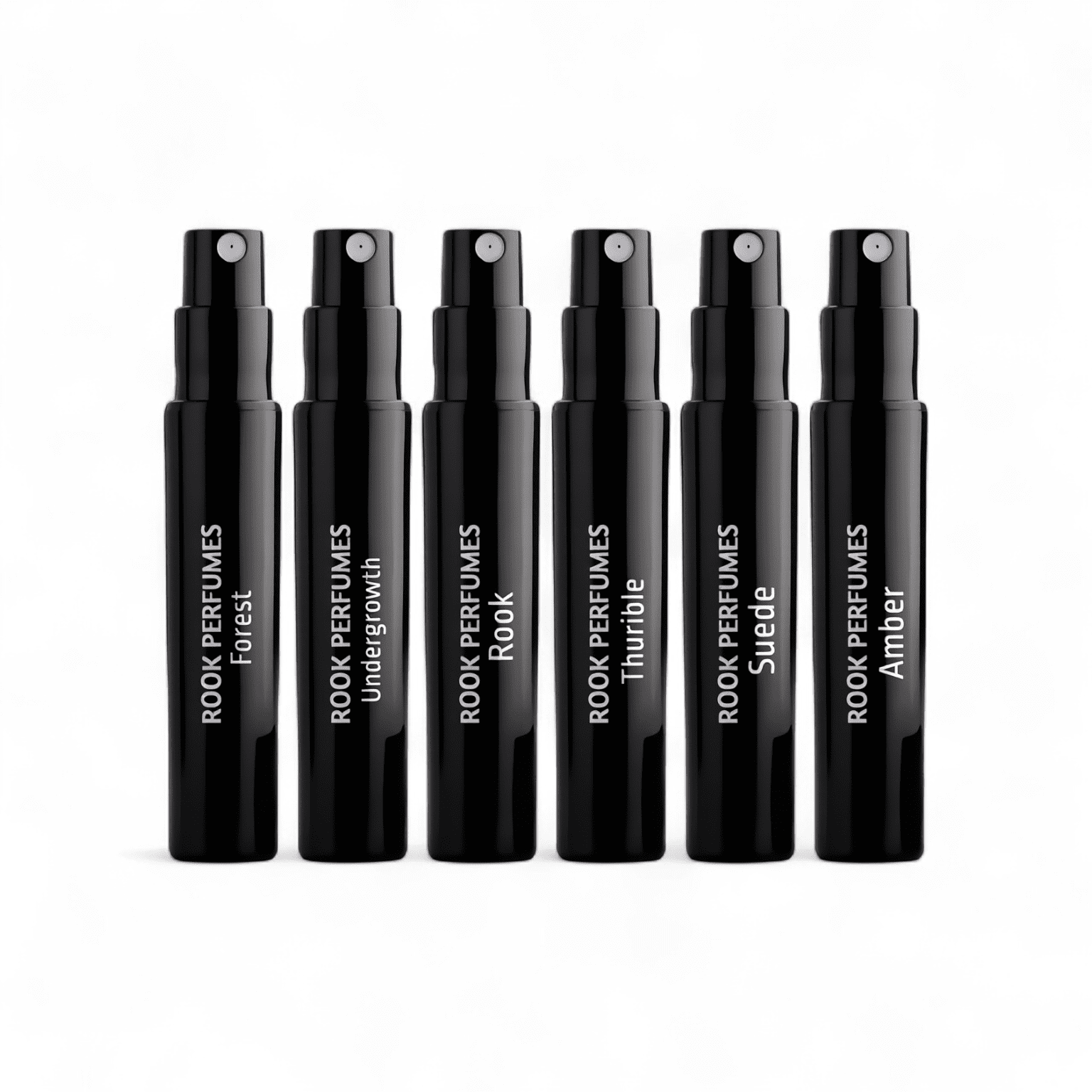
Practically speaking, if you want to know how a fragrance will behave on you specifically, the only honest answer is to wear it, not smell it on a card. That’s the entire logic behind a discovery sample set: several fragrances, small enough quantities to test properly over a few days each, low enough cost that trying five scents doesn’t mean committing to five full bottles. We’ve written more about how a composition comes together, including how a perfume actually gets built, for anyone who wants the fuller picture before they test.
Is “skin chemistry” even the right way to think about this?
“Skin chemistry” is a phrase that promises more than it delivers. It suggests some unique reaction happening only in your body, which sells nicely but overstates what’s actually going on. What’s really happening is a set of physical variables, oil, warmth, moisture, doing predictable, testable things to evaporation speed and note emphasis.
The useful version of the idea is narrower: your skin’s oil and heat genuinely do shift which notes you notice and for how long. The unhelpful version is the implication that a fragrance either “works” or “doesn’t work” with your body in some fixed, mysterious way. Most perfumes remain entirely recognisable on almost anyone, just with the volume dial turned slightly differently on different notes.
Drop the mystique and you’re left with something far more useful: a short list of variables you can control, and a testing method that tells you, within a few days, exactly how a fragrance behaves on you.
— Rook
Try it on your own skin before you commit
Reading about oiliness and evaporation only gets you so far. The next step is smelling a fragrance on your own wrist over a full day, and Rookperfumes built the Discovery Set Sampler for exactly that, a low-cost way to wear-test several scents properly instead of guessing from a single spritz in a shop.
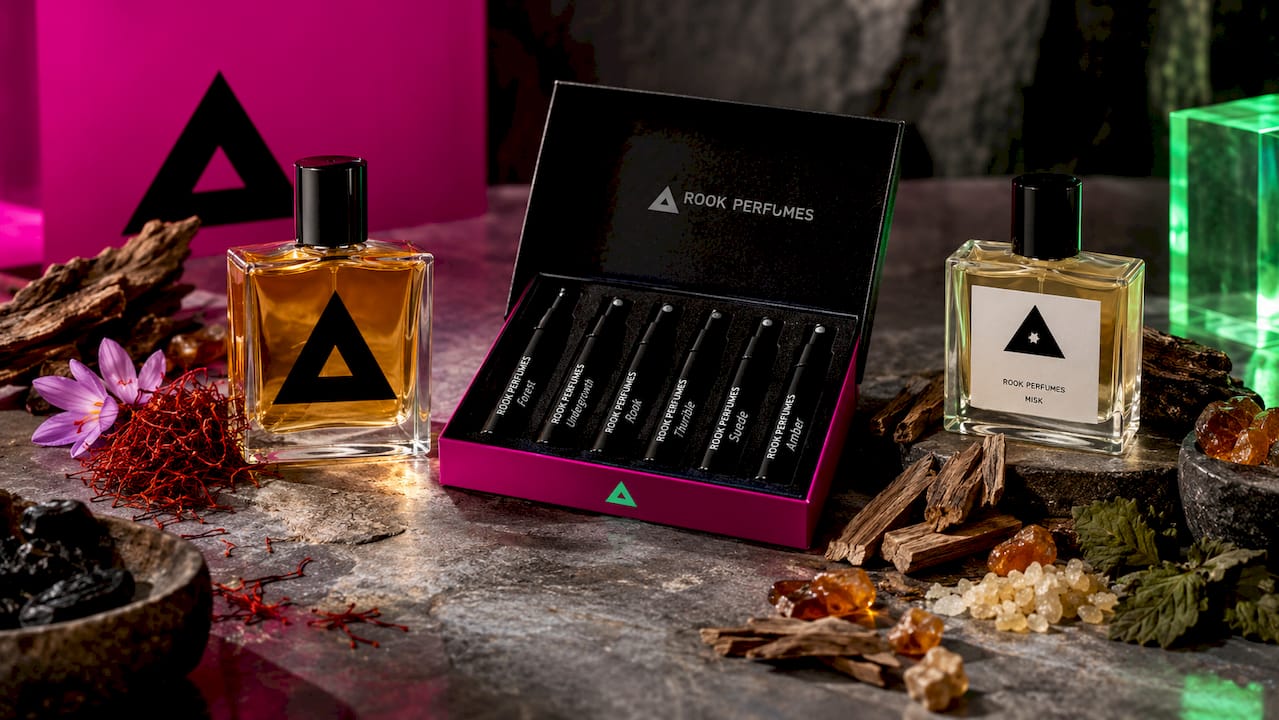
Two fragrances worth testing side by side if you want to see how skin type shifts a composition: the Amber Eau de Parfum, a smoky saffron and amber profile that tends to deepen further on oilier skin, and Misk Eau de Parfum, a patchouli and musk composition that behaves differently again depending on your skin’s warmth and hydration. Order the sampler, wear each scent across its own day using the three-checkpoint method above, and you’ll know within a week which one actually suits you, not just which one smelled good on a card. Every fragrance is designed to be cruelty-free and unisex, with an emphasis on sustainable practices. Start with the sampler, then move to a full bottle once you’ve identified a fragrance you enjoy on your own skin.
Sources
For readers who want the primary evidence behind these claims:
- Personal care products disrupt the human oxidation field | Science Advances
- Study on physical and chemical interactions between skin and perfume (headspace and solvent swabbing)
- Detection of fragrances on the skin using infrared and Raman spectroscopy
FAQ
How do I know my skin chemistry for perfume?
You don’t diagnose it in the abstract; you test for it. Wear a fragrance for a full day, checking it at 30 minutes, 3 hours and 6-plus hours, and note whether it fades fast (drier or cooler skin) or deepens and lasts (oilier or warmer skin).
Which celebrity wears Gypsy Water?
Gypsy Water is a Byredo fragrance widely associated with several celebrities in fashion and entertainment circles, though individual wear preferences change often and aren’t something a fragrance house can verify. It’s better used as a reference point for a woody, incense-led style than as a buying decision on its own.
Is Good Chemistry a good perfume brand?
Good Chemistry is a mainstream, mass-market fragrance line, generally well regarded for the price point but built around conventional, widely appealing profiles rather than niche or artisanal compositions. Shoppers looking for distinctive, story-led scents with sustainable or cruelty-free credentials, the focus of a brand like Rookperfumes, are typically after a different category altogether.
What is the best skin scent perfume?
There’s no single best skin scent because the effect depends on your own oil and warmth levels, but musk, amber and patchouli-based compositions, like Misk Eau de Parfum, tend to sit closest to the skin and read as warm rather than sprayed-on for most wearers.
Why does perfume smell different on different people?
Mainly evaporation speed. Oilier, warmer skin slows fragrance release and emphasises base notes, while drier, cooler skin lets top notes burn off fast, so the same bottle can read completely differently within the first hour on two different people.
0 comentários